Terminator 2: Judgment Day: Why James Cameron's 1991 Masterpiece Still Feels Like Tomorrow's News
TL;DR: Forget nostalgia. James Cameron's Terminator 2: Judgment Day isn't just a classic; it's a shockingly relevant blueprint for our AI-driven future and a masterclass in visual effects that still holds up. We'll break down why its predictions are so uncanny, where its CGI redefined Hollywood, and crucially, where to stream it right now.
Thirty-three years later, Terminator 2: Judgment Day isn't just a beloved action film. It's a crystal ball. Released on July 3, 1991, James Cameron's sequel fundamentally shifted what audiences — and Hollywood — believed was possible, both on screen and, eerily, in the world outside. JoBlo recently noted the film was "decades ahead of its time, from groundbreaking VFX to its eerily relevant AI themes," and honestly, it’s hard to argue. This isn't just anniversary hype. It's a measurable, verifiable truth that keeps getting clearer with every passing year.
Why T2's AI Predictions Are So Eerie Today
This is where T2 transcends mere science fiction. What was once dramatic shorthand for "smart machine" now reads like a surprisingly accurate roadmap for AI development.
According to Screen Rant's expert analysis, AI researcher Sasha Luccioni reviewed the film’s depiction of machine behavior and came away genuinely impressed by certain sequences. Think about the early scenes with the T-800: scanning environments, reading license plates, estimating human physical measurements, processing visual data in real time. These aren't just cool movie tricks. These are accurate descriptions of tasks that modern computer vision systems perform routinely. It's a textbook example of a film predicting practical AI applications without explicitly trying to.
Luccioni did, however, draw a line at the T-800’s hand-to-hand combat. The ability for a machine to anticipate and react to human unpredictability in a physical fight is something current AI systems genuinely struggle with — and it's a good reminder that Hollywood still takes some liberties. Still, getting partial credit from an actual AI researcher is more than most sci-fi films ever earn.
What strikes me is that Cameron wasn't operating from a technical brief when he wrote these scenes. He was crafting a compelling story, using observation and calculation as character traits for the machine. The fact that his dramatic instincts turned out to be so technically prescient is either a remarkable coincidence or a sign he was paying far closer attention to nascent AI research in 1990 than anyone realized.
Beyond the technical accuracy, T2 also nails the broader cultural moment. Skynet, the fictional AI network that triggers nuclear war, has moved from movie villain to a legitimate reference point in policy discussions about autonomous weapons and AI governance. That wasn't true in 1991. Now, as concerns about large language models, autonomous decision-making systems, and AI in military applications dominate headlines, the film's central premise — what happens when automated systems are given objectives without ethical constraints — feels less like fiction and more like a warning.
The film also does something few AI thrillers dare: it gives the machine a redemptive arc. The T-800’s gradual learning of human emotion — the thumbs-up at the end, John Connor teaching it "Hasta la vista, baby" — is sentimental, sure. But it complicates the pure threat narrative in a way that feels more honest about how humans actually relate to technology. We anthropomorphize. We attach. We teach machines our slang. T2 understood this human element, too.
The VFX That Changed Hollywood (and Still Hold Up)
The T-1000's liquid-metal transformations weren't just impressive for 1991. They were a proof-of-concept for computer-generated imagery as a storytelling tool, not just a novelty. Industrial Light & Magic (ILM) built on techniques pioneered for the water tentacle in Cameron's The Abyss (1989), extending that morphing logic to a full character performance. The result was something that looked — and still looks — physically convincing in a way that a lot of early-2000s CGI simply doesn't.
Compare it to The Matrix (1999), another film that pushed visual effects boundaries. The bullet-time photography in that film, iconic as it is, dates it in a way the T-1000 doesn't. There’s something about practical-CGI hybrids, where physical and digital elements are layered rather than entirely substituted, that ages differently. More honestly, maybe. T2 used Robert Patrick's physical performance as the foundation, applying digital transformation on top. You’re still watching an actor. The technology served the performance.
If you’re looking to compare these visual effect milestones, Movie OTT tracks streaming availability across regions, making it easy to watch both films back-to-back and draw your own conclusions about visual effects longevity. It's a genuinely interesting exercise in film history.
Key Facts: Cast, Runtime, and What to Expect
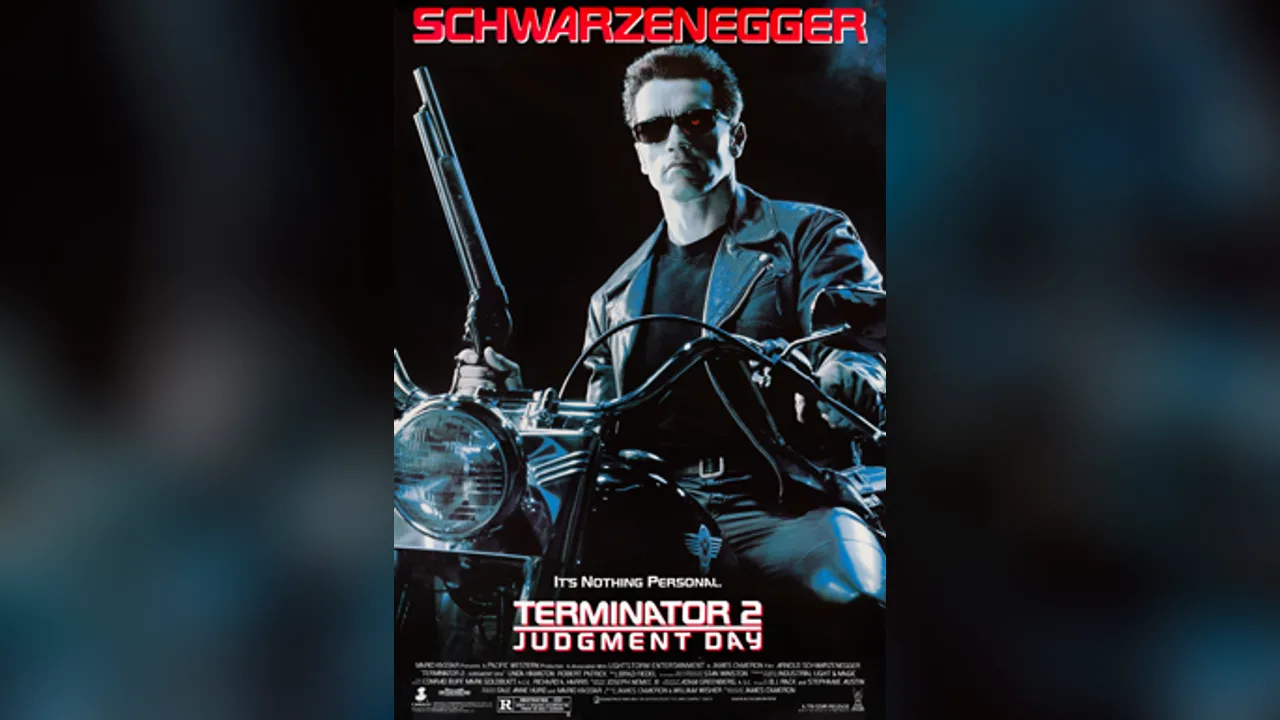
Directed by James Cameron, T2 stars Arnold Schwarzenegger as a reprogrammed T-800 Terminator sent back to protect teenage John Connor, played by Edward Furlong in his film debut. Linda Hamilton returns as Sarah Connor — her physical transformation between films remains one of the most committed character evolutions in franchise history. Robert Patrick is chilling as the T-1000, a liquid-metal Terminator from the future. Quietly relentless. The way he walks through a closing elevator door in the Galleria mall scene still sends shivers down my spine.
Key facts at a glance:
- Release date: July 3, 1991 (US theatrical)
- Runtime: 137 minutes (theatrical cut); 154 minutes (Special Edition)
- Director: James Cameron
- Studio: TriStar Pictures / Carolco Pictures
- Production budget: ~$102 million (the most expensive film ever made at the time)
- Global box office: ~$520 million
- Awards: Won 4 Academy Awards, including Best Visual Effects. A big night for the technical wizards.
The film was greenlit in 1990 by producer Andrew Vajna after years of legal and creative negotiations. Cameron had a specific vision, and that ambition pushed ILM into uncharted technical territory, proving that big risks could yield even bigger rewards.
Where to Watch Terminator 2 Right Now — Globally
Streaming availability shifts constantly, so always verify current status. Here’s a snapshot as of mid-2025:
- United States: Available for rental/purchase on Amazon Prime Video, Apple TV, Vudu, and YouTube Movies. Check Movie OTT's where-to-watch tracker for the most current SVOD listings; they keep things updated.
- United Kingdom: Available on Sky Cinema and NOW TV. Also for digital rental via Amazon and Apple TV.
- Spain: Find it on Movistar+ and other digital rental platforms.
- India: Currently on Amazon Prime Video India (with Hindi, Tamil, and Telugu dub options). Also for rental on Apple TV India. More details below.
Why T2 Resonates in India's AI Landscape
India has always had an enthusiastic relationship with Arnold Schwarzenegger's action films. Classics like Total Recall and the original Terminator built a loyal audience in the 1990s through satellite television and video rentals, often in dubbed versions, long before streaming made international cinema widely accessible.
T2 is currently streaming on Amazon Prime Video India, which is significant. Prime's extensive Hindi dubbing catalog and regional reach — including tier-2 and tier-3 cities — means this film is more accessible to a wider Indian audience than ever before. While the Hindi dub preserves the film's action beats effectively, some of the emotional nuance in Linda Hamilton's performance can lose a little texture in translation.
For Indian viewers discovering the film now, the AI themes may actually hit differently than they did for Western audiences in 1991. India's rapid expansion in AI adoption — from government facial recognition programs to AI-assisted agriculture and finance — means the questions T2 raises about autonomous systems and human oversight aren't abstract concepts. They're in the daily news cycle. Movie OTT tracks Indian streaming availability across major platforms like Netflix, Prime Video, and Hotstar, so if availability shifts, you'll find the current picture there. Prime Video currently holds the streaming rights for the subcontinent.
Cameron, Schwarzenegger, and the Legacy They Built
James Cameron directed the original The Terminator in 1984 on a budget of approximately $6.4 million. That film launched both his career and Schwarzenegger's transition from bodybuilder-actor to genuine movie star. The sequel arrived seven years later, and Cameron used every one of those years to develop the technology required to execute his ambitious vision. He’s done this repeatedly throughout his career: Titanic (1997), Avatar (2009), Avatar: The Way of Water (2022) all represent Cameron waiting until the tools existed to make the film he wanted. True visionary.
Schwarzenegger was 43 when T2 released. His performance here is physically precise in a way that perfectly serves the character — the T-800's deliberate, slightly inhuman movement patterns are a performance choice, not just a limitation. He’d played the T-800 once before, but the sequel required him to play the same character with the opposite moral alignment, and he calibrates that warmth convincingly without ever losing the machine underneath.
Linda Hamilton, meanwhile, trained extensively for her role — reportedly following a rigorous fitness and weapons-handling regimen for months before filming. The result is one of the most physically credible female action performances of the era, profoundly influencing how action cinema wrote and cast women for the better part of a decade.
The franchise has continued through four additional films (Terminator 3, Salvation, Genisys, Dark Fate) and a television series (The Sarah Connor Chronicles). Honestly, none have matched T2's cultural or critical weight. You can find the full franchise timeline on Wikipedia's comprehensive Terminator 2 entry.
What's Next for Terminator — and T2 — in 2025 and Beyond
A new Terminator project has been in various stages of development at Netflix, with Cameron reportedly involved in a producing capacity. No firm release date has been confirmed as of mid-2025, but the renewed interest in AI-themed science fiction — driven partly by real-world AI developments and partly by the success of films like M3GAN and Ex Machina on streaming — has made the Terminator intellectual property commercially attractive again.
For Terminator 2: Judgment Day specifically, the 4K restoration released in recent years has introduced the film to a new generation of viewers who encounter it in better visual quality than audiences saw in 1991. If you've never seen it, start with the theatrical cut. It works. For longtime fans, the Special Edition offers deeper character beats. Either way, it's a film that demands to be seen.