



The story of Akai nawa: Hateru made
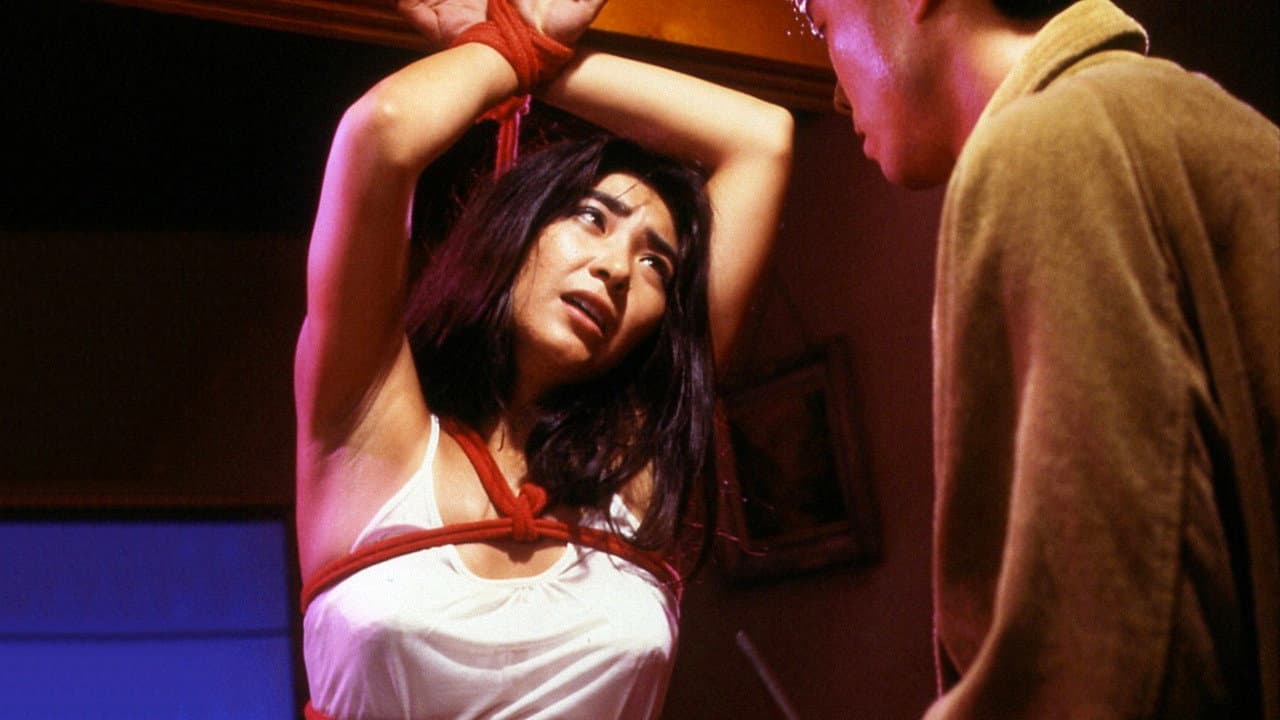
Akai nawa: Hateru made emerges from the late-1980s Japanese cinema landscape as a film that refuses to soften its central premise. The narrative follows an ordinary salary-man—a figure of conformity and restraint—who finds himself trapped in a marriage that can't accommodate his deepest desires. His world shifts when he spots a woman on the subway bearing an unmistakable mark: a rope burn on her wrist. That single visual cue becomes an invitation, a recognition between two people who understand something the rest of the commuting crowd doesn't. What unfolds is a sadomasochistic relationship that becomes the film's true subject—not sensationalism for its own sake, but an exploration of how desire, shame, and connection intertwine in the lives of people who can't quite fit into society's prescribed roles.
Behind the making of Akai nawa: Hateru made
Produced by Nikkatsu Corporation in 1987, Akai nawa: Hateru made arrived during a period when the legendary studio was experimenting with provocative subject matter. Nikkatsu had already built its reputation on pushing boundaries, and this 68-minute drama sits comfortably within that legacy. The production values reflect the era—the film moves with a deliberate pace that feels distinctly pre-digital, and the cinematography captures Tokyo's urban anonymity in ways that amplify the protagonist's isolation. While the picture didn't achieve mainstream box office success (it remains a relatively obscure entry in Japanese cinema's broader catalog), it's precisely this marginality that's allowed it to persist in festival circuits and among cinephiles who hunt for overlooked work from the period. The film carries an IMDb rating of 5.5/10, which tells you something: it's divisive, challenging, and not designed to please everyone. That resistance is partly the point. Nikkatsu's willingness to fund a project this uncomfortable—one that doesn't moralize or provide easy answers—speaks to a different era of studio filmmaking, before streaming algorithms and market research homogenized what gets greenlit.
What makes Akai nawa: Hateru made stand out
What's striking about the film is how it refuses to judge its characters. The salary-man isn't presented as a deviant to be pitied or condemned; he's shown as someone whose interior life simply doesn't match the exterior he's been asked to maintain. The woman with the rope burn isn't a victim waiting for rescue—she's an active participant in something that, for both of them, feels like recognition. I keep coming back to how the film treats their encounters without prurience, which is harder than it sounds. Many films about transgressive sexuality lean into titillation or moral panic, but Akai nawa: Hateru made seems genuinely interested in the emotional texture of desire that doesn't fit neatly into mainstream narratives. The performances anchor this approach—there's a restraint in how the actors move through scenes, a kind of quiet intensity that suggests depths the dialogue doesn't spell out. The horror elements creep in not as jump scares but as a slow-building dread about what happens when two people who've found each other become dependent on that connection. It's psychological rather than visceral, which gives the film a lingering quality. You don't shake it off immediately after watching.
Where to stream Akai nawa: Hateru made online
Finding Akai nawa: Hateru made requires a bit of patience, but the film is currently available on major OTT services—the Movie OTT platform tracks streaming availability across multiple providers, so you can check exactly where it's playing in your region right now. The film's obscurity actually works in its favor here; it's the kind of title that lives on specialty streaming services alongside other cult imports and archive releases. Because of its niche status, availability does shift seasonally, so if you're hunting for it, the Where to Watch widget at the top of this page will show you the most current options. The 68-minute runtime makes it manageable even for viewers hesitant about diving into something unfamiliar, and streaming's on-demand nature means you're not committed to a theatrical experience or a cable schedule—you can pause, step back, and return to it if needed.
Frequently asked questions
Q: Who directed Akai nawa: Hateru made?
The film was produced by Nikkatsu Corporation in 1987, though directorial attribution isn't widely documented in English-language sources. This gap in readily available information is actually part of what makes the film interesting to hunt down—it's a genuine deep cut.
Q: Is Akai nawa: Hateru made based on a true story?
There's no evidence the film adapts real events. It's an original drama exploring fictional characters and a scenario designed to interrogate taboo desires and the gap between public identity and private need.
Q: How long is Akai nawa: Hateru made?
The film runs 68 minutes, making it a compact viewing experience that doesn't overstay its welcome despite its heavy thematic material.
Q: What genres does Akai nawa: Hateru made fall into?
It's classified as both drama and horror, though the horror elements are psychological rather than conventional—the dread builds from character interaction and emotional stakes rather than external threats.
Q: Why is Akai nawa: Hateru made hard to find?
The film's limited theatrical release, modest box office performance, and niche subject matter kept it from entering mainstream circulation. It's the kind of work that survives through film festivals, archives, and streaming's ability to catalog obscure international titles.
Final thoughts on Akai nawa: Hateru made
Akai nawa: Hateru made isn't a film for everyone—and that's not a criticism, it's a fact. It's deliberately paced, morally ambiguous, and interested in desire as something that can't be tidied up or resolved. If you're drawn to cinema that takes risks, that treats adult sexuality as a legitimate subject for serious dramatic exploration, or you're simply curious about what Japanese studios were producing in the late 1980s, it's worth tracking down. The film respects its audience enough not to explain everything, which means you'll carry questions with you after it ends. That's the mark of work that actually matters.