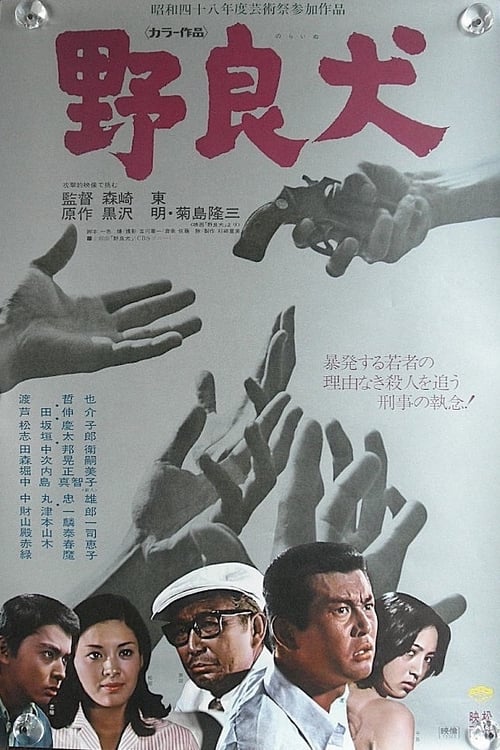
The story of Black Snow and its Tokyo underworld setting
Black Snow is a 1965 Japanese crime drama that pulls you into the shadows of post-war Tokyo. Directed by Tetsuji Takechi, the film follows a woman whose life becomes entangled with the city's criminal networks—a descent that unfolds with the kind of moral ambiguity that refuses easy judgment. The narrative doesn't offer redemption arcs or tidy resolutions. Instead, it presents a world where survival often means compromise, and compromise often means complicity. What makes the film particularly striking is how it treats its protagonist not as a victim to be pitied, but as an active participant in her own fate, making choices that ripple outward with real consequences.
The ensemble cast—including Kotobuki Hananomoto, Chitose Kurenai, Chieko Murata, and Keiko Mizumachi—grounds the story in lived experience rather than melodrama. Each character feels like someone you might actually encounter, flawed and desperate and sometimes cruel. The film's Japanese setting gives it a distinct texture from Western crime cinema of the same era. Tokyo itself becomes a character—crowded, indifferent, offering both opportunity and entrapment to those willing to reach for it.
Behind the making of Black Snow and Tetsuji Takechi's directorial vision
Tetsuji Takechi was a provocative filmmaker who didn't shy away from controversial material, and Black Snow sits squarely in that tradition. The 1965 release came during a fascinating period in Japanese cinema, when post-war filmmaking was grappling with themes of social dislocation, economic inequality, and the lingering moral wounds of conflict. Takechi's approach was unflinching—he wasn't interested in prettifying Tokyo or its inhabitants. The unrated status of the film reflects both its era and its content; it contains material that would've raised eyebrows in 1965 and still carries weight today.
The production brought together a working cast of character actors who understood the rhythms of crime and desperation. Takechi's direction emphasizes naturalism over spectacle. There's no swelling orchestral score to tell you how to feel; instead, the film trusts its performances and its mise-en-scène to communicate the texture of this world. The cinematography captures Tokyo's streets with a documentary-like clarity that makes the criminal enterprise feel less like a plot device and more like an economic reality—something that exists because the legitimate world has failed certain people.
While Black Snow didn't achieve the international distribution or festival circuit fame of some of Takechi's contemporaries, it remains a solid entry in the director's body of work, earning a 6.3 rating on IMDb from 153 votes—a modest but respectable score that suggests those who've discovered it recognize its merits. The film's rarity on streaming platforms has kept it somewhat obscure outside Japan, but its availability on Movie OTT and other aggregators means it's finally accessible to viewers curious about Japanese genre cinema beyond the samurai and monster-movie stereotypes.
What makes Black Snow stand out in 1960s crime cinema
Here's what's striking about Black Snow: it doesn't fetishize its criminals. There's no cool-guy mythology, no Robin Hood narrative. Instead, Takechi presents organized crime as a mundane bureaucracy of exploitation, where violence is less about honor and more about maintaining profit margins. The performances reflect this—they're restrained, almost tired, as if everyone involved knows exactly how this ends and is just going through the motions until it does.
The film's thematic core circles around complicity and choice. A woman doesn't stumble into the underworld by accident; she walks into it because the alternatives—poverty, invisibility, powerlessness—feel worse. That's a harder story to tell than "innocent person corrupted by bad people," and Takechi doesn't flinch from it. The supporting characters—Yōichirō Mikawa, Yasuko Matsui, and Takako Uchida among them—add layers of moral complexity. Everyone's got a reason. Nobody's purely villainous, and nobody's purely sympathetic. That ambiguity is what lingers.
What I keep coming back to is the film's refusal to moralize. It observes rather than judges. In an era when crime cinema often leaned on either noir cynicism or social-problem earnestness, Black Snow sits in a different register—it's almost anthropological, watching how people behave when the rules are loose and the stakes are high. The cinematography supports this approach: steady, observant, never sensationalizing. When violence happens, it's abrupt and unglamorous. When characters make deals, they're motivated by hunger, not ideology.
Where to stream Black Snow online
If you're hunting for Black Snow, you'll find it available on Prime Video. The film's accessibility through Prime Video—one of the major streaming platforms tracked by Movie OTT—makes it easier than ever to access Japanese cinema from this period without needing to hunt through specialty video stores or import DVDs. The streaming availability isn't guaranteed forever, so if you're intrigued, it's worth adding it to your watchlist sooner rather than later. Streaming platforms rotate their catalogs constantly, and a film as specific and unmarketable as Black Snow could vanish without warning.
When you stream it, go in expecting a slow burn. This isn't a film designed for half-attention or multitasking. The pacing is deliberate, the dialogue sometimes sparse, and the payoffs are psychological rather than action-oriented. That's precisely what makes it worth your time—it trusts you to sit with discomfort and moral ambiguity rather than resolving everything neatly.
Frequently asked questions
Q: Who directed Black Snow?
Tetsuji Takechi directed Black Snow in 1965. Takechi was known for provocative, socially conscious filmmaking that didn't shy away from controversial subject matter. His directorial approach emphasized naturalism and moral complexity over conventional genre tropes.
Q: Where can I watch Black Snow?
Black Snow is currently available on Prime Video. You can check the Where to Watch widget at the top of this page for the most up-to-date streaming availability across platforms.
Q: What's the plot of Black Snow?
The film follows a woman whose life becomes entangled with Tokyo's criminal underworld in the post-war era. Rather than a traditional heist or crime narrative, it's a character study of complicity, survival, and the choices people make when legitimate options feel impossible.
Q: Is Black Snow based on a true story?
There's no evidence that Black Snow is directly adapted from a specific true crime case. Instead, it draws on the social realities of post-war Japan—economic inequality, organized crime, and urban desperation—to create a narrative that feels authentic even if the specific characters are fictional.
Q: What's the IMDb rating for Black Snow?
Black Snow has a 6.3 rating on IMDb based on 153 votes. While the vote count is modest, the rating reflects a film that's appreciated by those who've discovered it, even if it remains relatively obscure outside Japan and among serious cinema enthusiasts.
Final thoughts on who should watch Black Snow
Black Snow isn't for everyone. It won't give you the adrenaline rush of a heist film or the cathartic ending of a revenge story. What it will give you is a window into a specific moment in Japanese cinema and a meditation on moral compromise that feels as relevant now as it did in 1965. If you're interested in crime cinema beyond the American tradition, or if you want to understand how Japanese filmmakers approached genre material during the post-war era, this is essential. If you're the kind of viewer who appreciates slow-burn character work and isn't bothered by ambiguous endings, you'll find something here worth your time. Stream it on Prime Video, settle in, and don't expect easy answers.