The Story of Destroy All Monsters
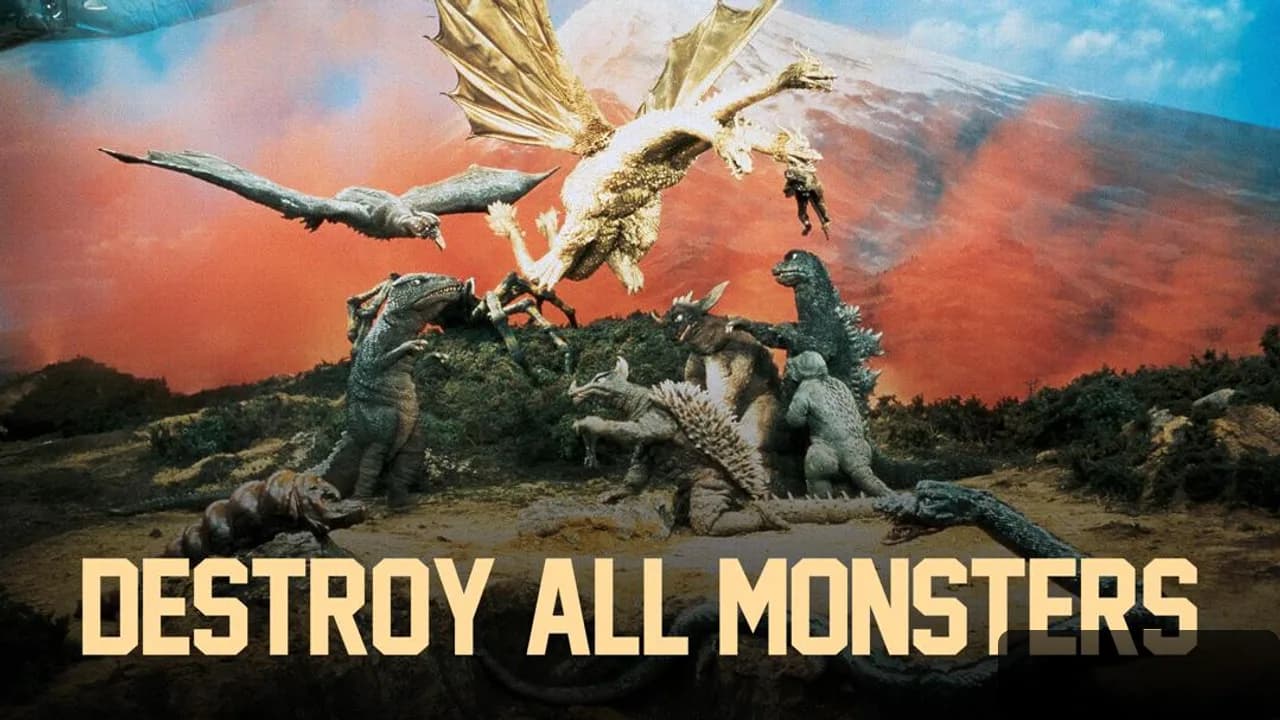
Destroy All Monsters unfolds as a straightforward but audacious premise: extraterrestrial invaders called the Kilaaks have somehow breached Monster Island and freed every giant creature held in captivity there. What follows is global chaos. Tokyo, Moscow, New York—major cities across the planet fall under assault from creatures that shouldn't exist outside a scientific containment facility. The film wastes no time establishing the stakes. By the opening act, you're watching Godzilla himself march through downtown Tokyo while military forces scramble to respond to an invasion they can't comprehend. The real conflict, though, emerges when a crew aboard the advanced spaceship SY-3 realizes the monsters aren't acting of their own accord—they're being controlled remotely by the Kilaaks from their hidden base. It's a race against time to infiltrate alien headquarters, expose the truth, and regain control before King Ghidrah, the three-headed dragon, levels what's left of civilization.
Behind the Making of Destroy All Monsters
Destroy All Monsters stands as the ninth installment in the Godzilla franchise, and by 1968, director Ishirō Honda had spent nearly a decade building this universe. The film represents something unusual for monster cinema of that era—a full-scale ensemble piece featuring not just Godzilla but Mothra, Rodan, Anguirus, and a dozen other creatures in coordinated action sequences. Honda, working alongside special effects supervisor Eiji Tsuburaya and effects director Sadamasa Arikawa, had to choreograph miniature city destruction on a scale the studio had never attempted. The budget reflected this ambition, and Toho Co., Ltd. distributed the film across Japan and internationally, banking on the franchise's proven appeal. The cast—including Akira Kubo, Jun Tazaki, Yukiko Kobayashi, and Yoshio Tsuchiya—anchored the human story with earnestness that grounded the spectacle. The film earned a G rating, making it accessible to younger audiences, though the destruction on screen is relentless. Critics and audiences responded warmly; the film currently holds an 82% Fresh rating on Rotten Tomatoes, suggesting that even decades later, the craft and ambition resonate with viewers.
What Makes Destroy All Monsters Stand Out
Here's what's striking about Destroy All Monsters: it doesn't apologize for its absurdity. The premise—aliens controlling giant monsters to destroy Earth—could've been played as campy, but Honda directs it with genuine gravity. The human characters face existential dread, not winking at the camera. What I keep coming back to is how the film manages to be both intimate and apocalyptic at once. You've got close-up scenes between crew members debating strategy, then cuts to wide shots of Godzilla flattening buildings. The thing nobody mentions is how much the film relies on practical coordination—actors in suits, miniature sets, careful cinematography—to sell the illusion of scale. When Godzilla and King Ghidrah clash in the final act, it's a genuine spectacle, not a digital shortcut. The performances hold their own too. Akira Kubo brings a kind of youthful determination to his role as a crew member willing to risk everything, while the ensemble cast conveys the weight of an invasion without descending into panic or melodrama. Tsuburaya's effects work—especially the destruction sequences and the monster choreography—remains impressive even by modern standards. The film doesn't drag; at 88 minutes, it moves with purpose from one crisis to the next.
Where to Stream Destroy All Monsters Online
Destroy All Monsters is currently available on Netflix, making it easy to revisit this 1968 classic without hunting through multiple platforms. The streaming availability varies by region, so check the Where to Watch widget at the top of this page to confirm access in your location. If you're tracking down the film across different services, Movie OTT aggregates current streaming data so you don't waste time searching. The G rating means it's family-friendly, though younger viewers might find the monster destruction intense. Netflix's catalog shifts regularly, so if you've been meaning to watch it, now's a good time—especially if you're working through the Godzilla films in order or diving into Ishirō Honda's directorial legacy.
Frequently asked questions
Q: Is Destroy All Monsters part of the Godzilla franchise?
Yes, it's the ninth film in the Godzilla series. The movie features Godzilla alongside other kaiju like Mothra, Rodan, and King Ghidrah, making it an ensemble monster film rather than a Godzilla-only story.
Q: Who directed Destroy All Monsters?
Ishirō Honda directed the film, with special effects supervised by Eiji Tsuburaya. Honda was a master of the kaiju genre and brought both spectacle and emotional weight to the story.
Q: What's the runtime of Destroy All Monsters?
The film runs 88 minutes, making it a lean, fast-paced adventure that doesn't overstay its welcome despite the scale of destruction on screen.
Q: Is Destroy All Monsters appropriate for kids?
The film is rated G, so it's technically suitable for all ages, though the monster destruction sequences might be intense for very young children. Parental discretion is always wise.
Q: Where can I watch Destroy All Monsters right now?
Destroy All Monsters is currently streaming on Netflix. Availability may vary by region, so check your local Netflix catalog or the Where to Watch widget to confirm access.
Final Thoughts on Destroy All Monsters
Destroy All Monsters doesn't reinvent the monster movie—it perfects it. Honda and his team understood that scale without heart is just noise, and heart without spectacle is just melodrama. This film refuses to pick between them. It's a film that respects both its audience's intelligence and their appetite for giant creatures destroying cities. If you haven't seen it, or if you're revisiting it after years, there's real value in watching how filmmakers solved impossible problems with practical effects and imagination. That's the kind of filmmaking worth your time.