The Story of Invisible Stripes
Invisible Stripes tells the story of a man caught between two worlds — the criminal past he's trying to escape and the legitimate future he desperately wants for himself and his younger brother. When a hardened ex-convict returns home after serving his time, he discovers that prison hasn't really let him go. The invisible stripes of his conviction mark him in ways that matter: employment doors close, legitimate opportunities dry up, and the pull of the underworld — the one place where his skills and reputation still hold currency — becomes almost irresistible. What unfolds is a battle not just against external circumstances, but against the man he was and the man he's determined to become, all while watching his brother drift toward the same mistakes that landed him inside.
The film's central tension isn't a heist or a shootout. It's psychological. The real conflict emerges when his younger brother shows signs of following the same path — the numbers racket, the betting parlor, the quick money that always comes with a price. What makes this premise work is that it's not about redemption coming easy. It's about a man who can't quite break free, who's haunted by his past, and who'll do anything to spare his brother the same fate.
Behind the Making of Invisible Stripes
Invisible Stripes emerged from Warner Bros.' commitment to crime dramas during the late 1930s, a period when the studio was churning out gritty, socially conscious pictures. Director Lloyd Bacon, a studio workhorse who'd helmed everything from musicals to gangster films, brought his efficient, no-nonsense style to the material. The screenplay by Warren Duff was adapted from a novel by Warden Lewis E. Lawes, a genuine prison reformer who'd spent decades inside the system and understood its human toll in ways most screenwriters couldn't fake. Lawes wasn't interested in sensationalism — he wanted audiences to understand why men came out of prison broken, and why the system itself often forced them back into crime.
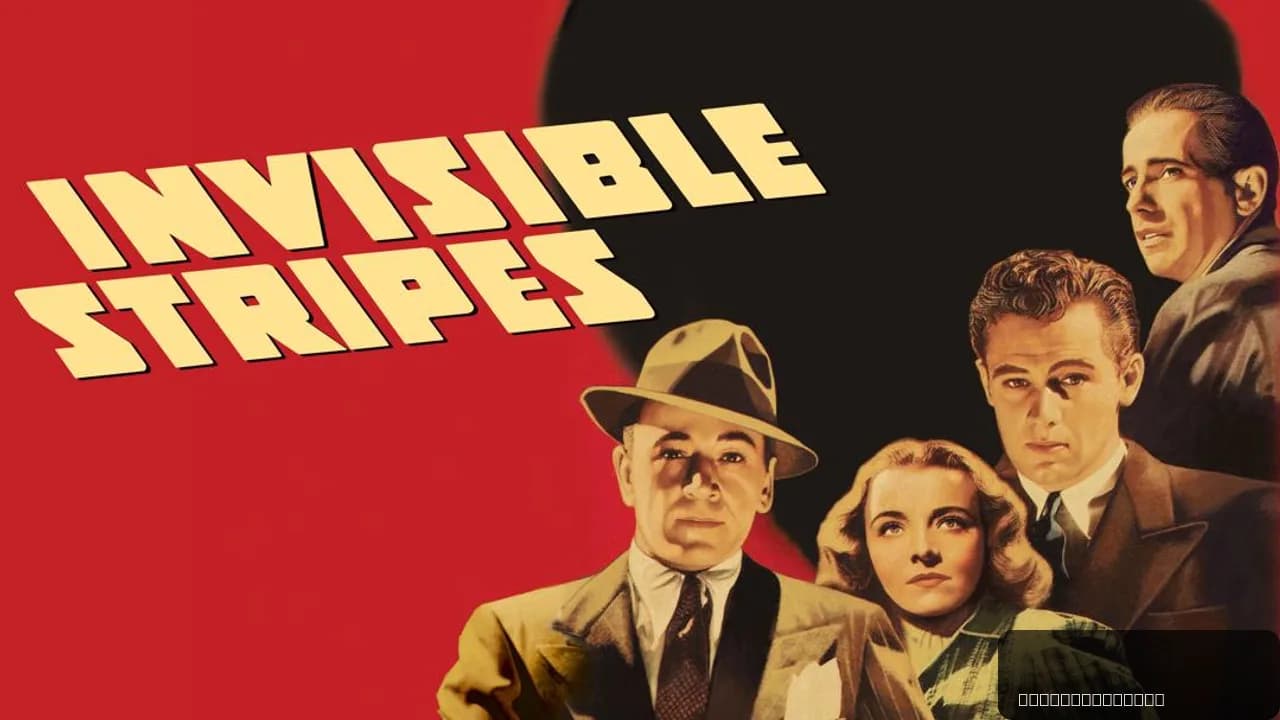
The cast assembled here reads like a master class in Hollywood talent at different stages of their careers. George Raft, already an established star known for playing tough guys with a certain world-weary charm, anchors the film as the ex-con protagonist. But what's remarkable is the supporting cast: William Holden, not yet the major star he'd become, plays his younger brother with genuine vulnerability. Humphrey Bogart appears in a smaller role — this was 1939, before he'd become the icon we know, though his presence already carries weight. Jane Bryan, Flora Robson, Paul Kelly, and Lee Patrick round out an ensemble that brings real depth to what could've been stock characters. The film runs 82 minutes, a tight runtime that keeps the moral tension wound tight without letting it slacken.
Box office and awards recognition for Invisible Stripes were modest by today's standards, but the picture was taken seriously as a piece of studio craftsmanship. It's the kind of mid-tier Warner Bros. production that doesn't make headlines but gets remembered by people who actually care about 1930s cinema — the kind of film that Movie OTT helps surface for viewers digging deeper into streaming catalogs.
What Makes Invisible Stripes Stand Out
What's striking about Invisible Stripes is how it refuses to let you off easy with its moral calculus. The film doesn't present crime as glamorous or exciting — it's presented as a trap, a system that perpetuates itself. A man gets out of prison and finds that society won't let him be anything but what he was. That's a bleak vision, and the film doesn't shy away from it. Raft's performance carries a weariness that goes beyond tough-guy posturing. There's a scene where he's offered legitimate work at a garage, and you can see the hope flicker across his face — and then watch it die when he realizes the wages won't cut it, that the straight life is going to be a grinding, humiliating struggle. It's that kind of specificity that makes the film work.
Bogart's appearance, though brief, carries an interesting weight. He plays a character who represents what the protagonist could become if he stays in the game too long — a warning in human form. The film's treatment of the numbers racket and betting parlor world is matter-of-fact rather than sensational. We're not watching a thrilling crime spree; we're watching a system that grinds people down. The jitterbug dancing that appears in the film's social sequences feels almost incongruous — a reminder that life goes on, that people still dance and laugh, even in the shadow of desperation.
I keep coming back to how the film handles the relationship between the brothers. It's not sentimental. The younger brother isn't some innocent being corrupted by a fallen world. He's tempted, drawn to quick money and status, the same way his older brother was. The tragedy isn't that he's innocent — it's that he's human, and the system doesn't give human beings much choice. That's what makes the older brother's struggle so urgent. He's not just trying to save his brother; he's trying to break a cycle that the film suggests is almost unbreakable.
Where to Stream Invisible Stripes Online
Invisible Stripes is available across multiple streaming platforms, making it easier than ever to track down this 1939 gem. You can stream it on Amazon Prime Video with Ads, HBO Max Amazon Channel, Max, Prime Video, Apple TV Store, Fandango At Home, Google Play Movies, and YouTube. The exact availability might vary depending on your region and subscription status — that's where Movie OTT's streaming widget comes in handy, showing you exactly which platforms currently have the film in your area. Whether you're a subscriber to one of the major services or prefer to rent or purchase individual titles, you've got options. For a film this deep in the Warner Bros. archive, the fact that it's available on so many platforms speaks to how seriously these services are taking their classic film libraries.
Frequently Asked Questions
Q: Who directed Invisible Stripes?
Lloyd Bacon directed the film. Bacon was a prolific Warner Bros. director known for his efficiency and versatility across multiple genres, from musicals to crime dramas. His no-nonsense approach suited the material's serious treatment of prison and redemption.
Q: Is Invisible Stripes based on a true story?
The film is based on a novel by Warden Lewis E. Lawes, a real prison reformer who spent decades working inside the system. While not a direct biography, Lawes brought authentic understanding of prison life and its aftermath to the source material, grounding the story in real experience rather than pure fiction.
Q: What's the runtime of Invisible Stripes?
The film runs 82 minutes, a brisk runtime that keeps the moral tension taut throughout without unnecessary padding. It's a lean, focused narrative.
Q: Where can I watch Invisible Stripes?
The film is currently available on multiple platforms including Amazon Prime Video with Ads, HBO Max Amazon Channel, Max, Prime Video, Apple TV Store, Fandango At Home, Google Play Movies, and YouTube. Check the streaming widget at the top of this page for current availability in your region.
Q: What's the IMDb rating for Invisible Stripes?
The film holds a 6.5/10 rating on IMDb, reflecting its status as a solid, well-crafted studio picture that's aged respectably rather than becoming a universally beloved classic. It's the kind of film that rewards patient viewing more than it announces itself.
Final Thoughts on Invisible Stripes
Invisible Stripes deserves a second look from anyone interested in 1930s cinema or the evolution of crime drama in Hollywood. It's not flashy. It won't blow your mind with technical innovation. But it's honest in a way that a lot of entertainment isn't — honest about systems that trap people, about the way society marks the formerly incarcerated, about how desperation can feel like the only rational choice. The performances anchor it, the direction keeps it moving, and the moral questions it raises don't have easy answers. That's the kind of film that sticks with you.