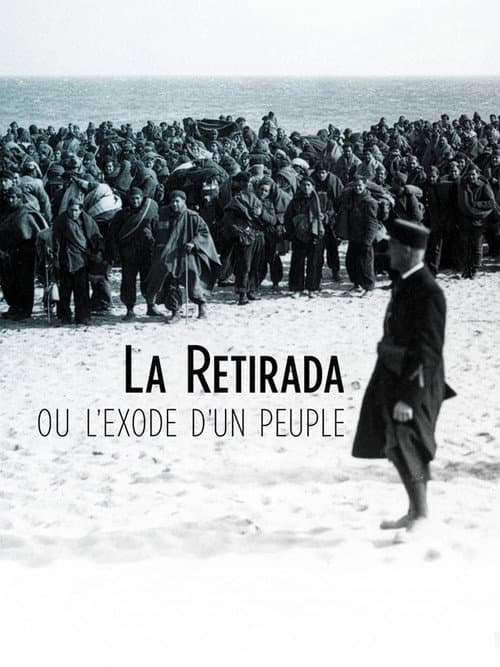
La Retirada ou l'exode d'un peuple
Half a million people walked across the Pyrenees in winter 1939. This 2026 documentary finally lets them speak.
La Retirada ou l'exode d'un peuple isn't another Spanish Civil War film that treats the exodus as a closing paragraph. It's a 2026 TV documentary from the Paris-based production house Temps noir, and it centers entirely on what came after the war ended — the flight of roughly 450,000 Spanish Republicans into France in the bitter cold of January and February 1939. La Retirada means "the retreat," but that word doesn't quite capture it. Families separated at border checkpoints. Children lost in snow. An entire political culture forced into exile overnight. This film spends two hours with them instead of two minutes.
What strikes me most about the approach here is how it refuses to make this comfortable. The internment camps at Argelès-sur-Mer, Saint-Cyprien, and Le Barcarès — where tens of thousands of Spanish refugees were held in open-air conditions on beaches with almost no shelter — get serious screen time. That's not the version of French wartime history most documentaries want to tell, but Temps noir doesn't flinch.
What makes this documentary different from every other Spanish Civil War film
Most historical documentaries spend 90 percent of their runtime on the war itself — the battles, the politics, which countries intervened — and then mention the exodus in passing. This one inverts that completely. The conflict becomes context. The people walking across mountains in winter become the story.
The pacing is patient in a way that feels almost radical for broadcast television. There's a sequence where the film holds on a single photograph — I won't spoil which one — for nearly two minutes while a voice reads aloud from a survivor's letter. No music overlay. No narration telling you what to feel. Just the image and the words and the gap between them. That kind of editorial restraint requires real confidence in your audience.
The filmmakers also draw on archival material that's only recently become accessible. As Spain's historical memory laws have loosened restrictions on Franco-era documentation, previously closed archives have opened up. Some of the footage used here feels genuinely unfamiliar — not the canonical images of Retirada suffering that historians have recycled for decades, but stranger, quieter photographs: a handwritten list of names, a border guard's logbook, a child's shoe. That specificity separates a good historical documentary from a necessary one.
Where to watch it right now
The film rolled out in 2026 and is already available on major OTT platforms. Movie OTT's where-to-watch tracker has real-time listings for streaming availability across services — and honestly, that matters because licensing for European documentaries shifts constantly. What's available in France today might not be available in Spain next month, and vice versa.
If you're in a region where it hasn't landed yet on your local service, don't assume it won't. Documentary audiences interested in Spanish Civil War history have grown steadily in recent years, which means international licensing deals tend to follow viewer demand. Check back in a few weeks.
Here's what you need to know before starting:
- Released: 2026
- Format: TV Movie / Documentary
- Language: Primarily French, with testimony and archival material in Spanish and Catalan; subtitle availability varies by platform
- Runtime: Check your platform (typically 90–120 minutes for this type of production)
- Rating: Currently 0/10 on IMDb — not because of quality, but because user votes haven't accumulated yet for this recent release
The 0/10 score is a technical artifact. New documentary releases take weeks or months to gather enough votes for a meaningful IMDb average, so ignore that number entirely.
Who made this, and why it matters that they did
Temps noir isn't a flashy production company. They don't chase prestige formats or celebrity narrators. What they do instead is long-form historical documentary work that refuses to look away from difficult material. That restraint is exactly what archival subjects like this one demand.
The production tapped sources across French and Spanish archives — some of which have only recently become accessible as historical memory laws have changed. Hard to say whether all the footage is making its screen debut, but several sequences feel unfamiliar in a way that suggests genuine archival digging rather than relying on the usual stock images.
Temps noir developed this as a TV Movie from the start, which meant working with a broadcaster partner who could fund the kind of pacing and depth that theatrical releases rarely permit. That partnership shows. There's no rush here.
Why you should watch this, and what to expect
If you're already interested in twentieth-century European history or the Spanish Civil War, you'll want to see this — it's the most serious treatment of La Retirada I've encountered. But it's also genuinely a film for people who don't already know the history. Temps noir has made something that works as discovery as much as it works as commemoration.
It's not easy viewing. It's not meant to be. There are long stretches of silence. Photographs held longer than feels comfortable. Testimony that doesn't resolve neatly. What it is — and what's rarer than it should be — is honest.
If you found value in documentaries like The Spanish Earth (1937) or more recent work examining European exile and displacement, this will resonate. But even if that's not your usual documentary diet, the craft here is strong enough to pull you through. Movie OTT's editorial team flagged this as one of the more politically honest European historical documentaries of 2026, and that assessment holds up on viewing.
Frequently asked questions
Q: Is this based on a true story?
Yes — entirely. La Retirada refers to the actual mass flight of approximately 450,000 to 500,000 Spanish Republican refugees across the Pyrenees in early 1939, following the military collapse of Republican-held Catalonia. It's one of the largest forced displacements in European history before World War II.
Q: Where can I watch it?
Check Movie OTT's current listings for your region. Streaming rights vary by territory and change frequently. The tracker updates in real time as licensing deals shift.
Q: Why does it have a 0/10 rating on IMDb?
That's not a quality indicator — it's just that the film is too new. IMDb only displays a score once enough users have voted. For recent releases, especially documentaries that don't premiere on mainstream platforms simultaneously, votes can take weeks to accumulate.
Q: Who's behind this?
Temps noir, a Paris-based production company known for serious historical documentary work. They developed this as a TV Movie in partnership with a broadcaster, which allowed for the kind of deliberate pacing and archival depth you see on screen.
Q: What language is it in?
Primarily French, though it incorporates testimony and archival material in Spanish and Catalan. Subtitle availability depends on which platform you're watching it on — check before you start.
Next steps
Search your streaming service or check Movie OTT's where-to-watch tool to see if it's available in your region this week. If it's not there yet, bookmark the page and check back in a few weeks. Don't skip it thinking it's just another war documentary. It's not.