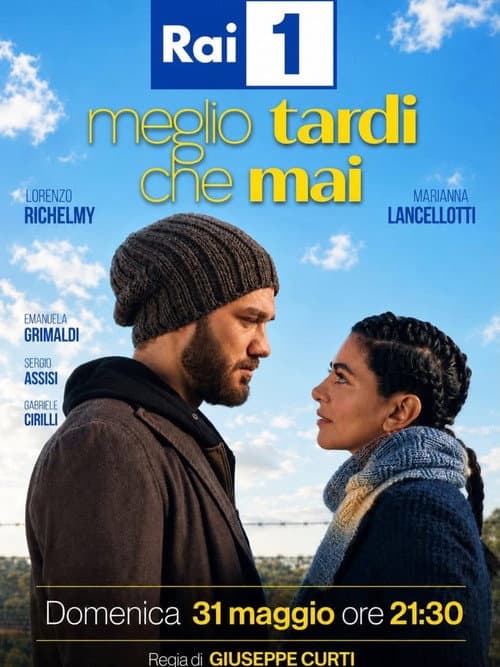
Meglio tardi che mai
The setup: A disgraced actor meets his past inside prison walls
Marco's career imploded in seconds. One on-set outburst, caught on camera, went viral — and suddenly the brilliant actor nobody wanted to hire is scrambling for any job that'll have him. His aunt throws him a lifeline: teach theatre to inmates at a women's prison in Bassano del Grappa. It's humiliating work. It's also his only option.
Then he walks into the rehearsal room and sees Arianna — his first love, now serving time for a crime she didn't commit.
Meglio tardi che mai (2026, 106 minutes) is that collision point. It doesn't rush the reunion. It sits in it, lets both characters feel the weight of what's been lost, what's been assumed, what might still be salvageable. If you've watched enough romantic dramas, you know where this ends. The film knows you know. Its job isn't to surprise you with the ending — it's to make you believe the two of them actually deserve to get there.
Why the casting and location choices matter
Lorenzo Richelmy — you might remember him from Netflix's Marco Polo — plays Marco with a specific kind of damage. He's magnetic and infuriating in equal measure, a man who's spent so long performing emotion that he's genuinely forgotten how to feel it without an audience watching. It's a harder performance than it looks.
Mariana Lancellotti carries Arianna with restraint that does real work. She doesn't announce her character's trauma — you feel it. The supporting cast (Gabriele Cirilli, Sergio Assisi, Emanuela Grimalda, Camilla Filippi, Claudio Corinaldesi) fills out the prison scenes with texture and occasional sharp comedy that keeps the tone from getting too heavy.
Here's what's worth knowing about the location: Bassano del Grappa isn't just a backdrop. Director Giuseppe Curti shot almost entirely on location over four concentrated weeks, using the town's historic centre, the Brenta river banks, and the famous Ponte Vecchio bridge as recurring visual anchors. The architecture does something specific — it makes everything look slightly more romantic than it probably is, which suits the material perfectly. Italy for Movies tracked the production's use of those spaces, and it's clear Curti understood that a small northern Italian town can be its own kind of character.
The scenes that actually land
There's a rehearsal sequence early on where Marco faces a room of skeptical, occasionally hostile women who have every reason not to care about Chekhov. Watch how Richelmy plays the discomfort — not as comedic flailing but as something more specific: a man discovering he's forgotten how to actually teach what he's spent years faking.
Midway through, there's an exchange where Marco and Arianna are ostensibly discussing a scene from a play. They're obviously talking about something else entirely. Curti has the good sense to let the camera sit still and let the actors work. No manipulative music. No reaction shots. Just two people circling something neither can quite name. It's small. It lands.
The comedy, when it comes, is earned. Cirilli and Assisi handle the lighter material with timing that keeps the film from feeling like it's fighting itself — which matters because this is a Purché finisca bene production, meaning the ending isn't in doubt. The pleasure is in watching the film get there honestly.
Where to watch (and why availability matters)
Meglio tardi che mai premiered in prime time on Rai 1 on May 31, 2026. It's a TV movie, not a theatrical release — produced by Pepito Produzioni and Rai Fiction as part of Rai's long-running anthology strand Purché finisca bene, a series of standalone romantic comedies that's built a loyal Saturday-night audience across Italy.
For Italian viewers, the film's natural home is Rai's streaming ecosystem. International distribution means it's surfacing on broader platforms too, though availability varies by region. The quickest way to find where it's playing near you is Movie OTT's where-to-watch widget, which updates in real time as platforms add and drop titles. (I know that sounds like a plug — it's genuinely useful if you hate running the same search across five different apps.)
The IMDb rating is 7/10, which for a TV movie in this genre signals solid audience approval rather than algorithmic noise.
The obvious questions answered
Should I watch it? If you're tired of romantic comedies that mistake noise for energy, yes. This one moves at human pace, in a beautiful location, with two leads who actually seem to understand what the other is doing. It doesn't reinvent the genre. It doesn't need to.
How long is it? 106 minutes. Lean enough that it doesn't overstay its welcome.
Who directed it? Giuseppe Curti for Rai Fiction.
What's the vibe? European TV drama with genuine craft. Warm without being saccharine. If you liked Purché finisca bene's previous releases or you're into Italian-language romantic dramas generally, this fits the pattern — but it's worth watching even if you've never heard of the anthology before.
When was it made? 2026. Recent enough that the production values are solid, the cinematography doesn't look dated (the Bassano locations help with that).
Who should actually watch this
Anyone who wants something well-made on a weekend evening. Anyone who's burned out on American romantic comedies. Anyone who likes European TV movies done without talking down to the audience. Anyone curious about how Italian public television quietly perfected the feel-good drama that doesn't sacrifice intelligence for warmth.
Find it on Movie OTT and check their regional breakdown to see which streaming service carries it where you are. It's the kind of film that rewards actually showing up rather than half-watching on your phone — so pick a moment when you can actually sit with it.
The rating is 7/10. The runtime is manageable. The location is stunning. Two of the leads know exactly what they're doing. That's enough.