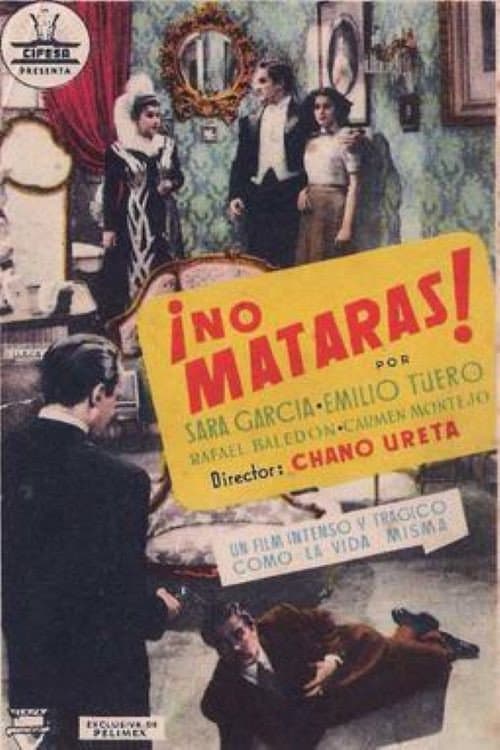







The story of No matarás and its exploration of family crisis
No matarás tells the story of a mother forced to confront the unraveling of her family when her daughter becomes caught in a vortex of marital infidelity, blackmail, and ultimately, murder. The title itself—Spanish for "Thou shalt not kill"—carries a moral weight that hangs over every scene. The film doesn't offer easy answers about guilt or innocence; instead, it observes how a family fractures when scandal touches it, and how silence—sometimes born of love, sometimes born of fear—becomes its own kind of complicity. What unfolds is less a whodunit and more a study of how ordinary people respond when their world is shattered by circumstances beyond their control.
Behind the making of No matarás and its production context
No matarás emerged from Clasa Films Mundiales in 1943, a production company working during a particular moment in Spanish cinema history. At 107 minutes, the film was substantial for its era—not a quick melodrama but a deliberate, character-driven piece that took time to build its moral landscape. The 1940s represented a complex period for Spanish film production, with studios navigating both artistic ambition and the constraints of the time. Though the film didn't generate the international box-office buzz of some contemporaries, it found an audience among viewers interested in serious dramatic work that treated its subject matter with gravity rather than sensationalism. The cast brought a professionalism and restraint to their roles that elevated the material beyond simple scandal-mongering—they played characters grappling with real consequences, not caricatures. Movie OTT has made it possible to revisit films like this one that might otherwise remain obscure, preserving access to cinema that deserves a second look across streaming platforms.
What makes No matarás stand out as a character study
What's striking about No matarás is how it refuses to simplify its moral terrain. The mother at the center of the story isn't a passive victim—she's a woman making active choices about what to protect, what to expose, and what to bear in silence. That's a more nuanced role than 1940s cinema often offered its female leads. The performances anchor the film's emotional weight; you're not watching actors deliver exposition, you're watching people try to hold themselves together while their lives come apart. The blackmail subplot could've been pure melodrama in less careful hands, but here it becomes a vehicle for exploring how desperation makes people capable of things they never imagined. I keep coming back to the central tension: how much can a mother sacrifice for her daughter? And at what point does protection become complicity? These aren't questions with clean resolutions, and the film doesn't pretend they have them. The craft on display—the pacing, the way scenes linger just long enough to let tension build—suggests a director who understood that sometimes the most powerful moments are the ones where nothing violent happens, just the slow recognition of how far we've fallen. Movie OTT's streaming catalog includes titles like this one that reward patient viewing and closer attention to character over plot mechanics.
Where to stream No matarás online
No matarás is currently available on major OTT services, making it accessible to anyone looking to explore mid-century Spanish drama. Check the "Where to Watch" widget at the top of this page to see which platforms currently carry the film in your region—availability shifts, so it's worth confirming before you settle in. Whether you're a film historian tracking the evolution of Spanish cinema or simply someone drawn to character-driven stories about moral compromise, you'll find the film waiting across several major streaming platforms. Movie OTT tracks current streaming availability across all major services, so you can find exactly where to watch without the usual frustration of hunting across five different apps.
Frequently asked questions
Q: What is the plot of No matarás?
The film centers on a mother who must stand by as her daughter becomes entangled in a scandal involving marital infidelity, blackmail, and murder. It's less a thriller and more a character study of how families respond when crisis strikes.
Q: When was No matarás released?
The film was released in 1943 by Clasa Films Mundiales, during a formative period in Spanish cinema.
Q: How long is No matarás?
The film runs 107 minutes, giving it enough time to develop its characters and moral questions with deliberate pacing rather than rushing through plot points.
Q: Is No matarás based on a true story?
There's no indication the film is based on a specific true event; rather, it explores universal themes of scandal, family loyalty, and moral compromise through a fictional narrative.
Q: What's the IMDb rating for No matarás?
The film holds a 5.6/10 rating on IMDb, which doesn't fully capture its merit as a character-driven drama that rewards engaged viewing over spectacle.
Final thoughts on No matarás
If you're tired of melodramas that treat scandal as pure entertainment, No matarás offers something different. It's a film that trusts its audience to sit with uncomfortable questions and unresolved moral tensions. The performances are restrained, the pacing deliberate, the emotional stakes genuine. It won't give you the cathartic resolution some viewers crave—but that refusal is exactly what makes it worth watching. For anyone exploring Movie OTT's deeper catalog or simply seeking drama that respects intelligence over sentiment, this 1943 Spanish-language film deserves your time.