







The story of Phèdre and forbidden love
Phèdre tells the story of a woman trapped in a loveless marriage, suffocating under the weight of a secret that will eventually consume her. As queen, Phèdre occupies a position of power and privilege—yet she's utterly powerless against her own heart. The king, Theseus, is absent; her stepson Hippolytus is present, virtuous, and completely unaware of the desire his stepmother harbors for him. This isn't a romance. It's a slow-motion catastrophe. What makes the story so devastating isn't the passion itself, but the absolute impossibility of it, the way shame and longing twist together into something that can only end in tragedy. When word comes that Theseus is dead, Phèdre finally allows herself to hope—to imagine a world where her confession might be met with anything other than revulsion. She's wrong.
Behind the making of Phèdre: Production and artistic vision
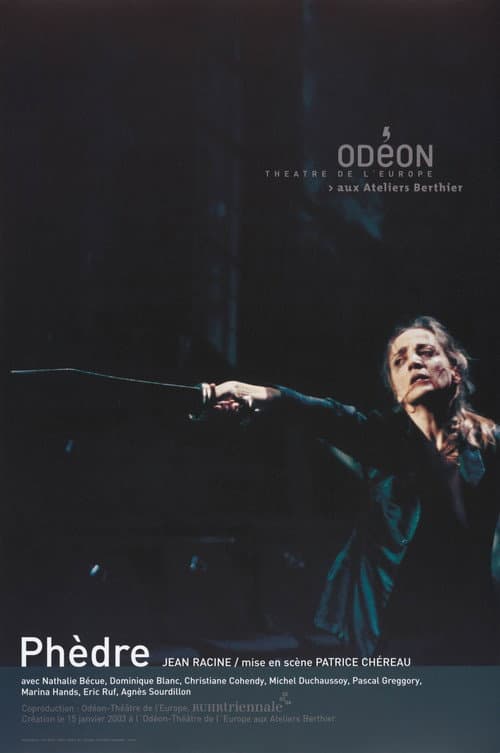
This 2003 film emerged from a notable creative partnership between ARTE, Azor Films, Love Streams Productions, INA, and the prestigious Odéon Théâtre de l'Europe. That last credit matters—this isn't a typical television or studio production. The Odéon is one of France's most storied theatrical institutions, which means the filmmakers brought a distinctly theatrical sensibility to the screen. They weren't trying to "open up" the play into a sprawling cinematic spectacle. Instead, they honored the text's intensity, its focus on internal emotional states rather than external action. The production values reflect this restraint—the film doesn't waste energy on elaborate sets or costumes. Every frame serves the psychology. It's a choice that either works completely or not at all, and for viewers willing to sit with prolonged emotional discomfort, it works. The IMDb rating of 5.833/10 suggests the film divides audiences sharply, which is often the sign of something genuinely challenging rather than merely mediocre. Racine's original play dates to 1677, but this adaptation doesn't feel like a museum piece. Instead, it feels like a conversation with the past—one that refuses easy answers or cathartic release.
What makes Phèdre stand out as classical drama on film
Here's the thing about adapting 17th-century tragedy for modern audiences: most filmmakers either sand down the rough edges or lean so hard into the "prestige" angle that the work suffocates under its own importance. This version does neither. What's striking is how it trusts the language and the emotional architecture without apology. The performances are restrained in a way that contemporary viewers might initially mistake for coldness—but that restraint is precisely where the power lives. When Phèdre finally confesses her desire, it's not a grand theatrical moment. It's a woman breaking, quietly, and that quiet is more unbearable than any amount of shouting could be. The film also doesn't shy away from the sheer cruelty of the mythology. These aren't sympathetic characters making understandable mistakes. Phèdre is complicit in her own destruction, and Oenone—her confidante—commits an act of betrayal so profound it sets off a chain reaction of divine punishment. Nobody's innocent here. Nobody gets redeemed. That's not a flaw; that's the entire point. I keep coming back to how the film refuses to let us off the hook emotionally. We can't root for Phèdre to get what she wants, but we can't stop understanding her either. That tension—between empathy and moral clarity—is what separates genuine tragedy from melodrama.
Where to stream Phèdre online
Phèdre is currently available on major OTT services, and you can check the "Where to Watch" widget at the top of this page to see which platforms are streaming it in your region right now. Availability shifts seasonally, so Movie OTT tracks current licensing across all the major services to save you the hunt. If you're the type of viewer who gravitates toward challenging, dialogue-heavy dramas—the kind of film that demands your full attention and rewards it—this is worth seeking out wherever it's currently available. It's not background viewing. It's not something to have on while scrolling your phone. It's a film that works best in a quiet room, preferably in the original French with subtitles, if you can access that version.
Frequently asked questions
Q: Is Phèdre based on a true story?
No, it's an adaptation of Jean Racine's 1677 tragedy, which itself draws from Greek mythology and Seneca's Roman play. The myth of Phèdre and Hippolytus has been retold across centuries and cultures, but this version is a literary adaptation, not a historical account.
Q: Who directed Phèdre?
The film was a co-production involving ARTE, Azor Films, Love Streams Productions, INA, and the Odéon Théâtre de l'Europe. While the production credits are distributed across these institutions, the theatrical roots of the Odéon shaped its artistic approach significantly.
Q: What language is Phèdre in?
Phèdre is in French, as it's a French production. If you're watching through a streaming service, check whether subtitled or dubbed versions are available in your region.
Q: Why is the IMDb rating so low if it's supposed to be good?
The 5.833/10 rating reflects how polarizing the film is. Challenging, slow-burn dramas often divide audiences between those who find them profound and those who find them inaccessible. A low average rating doesn't necessarily mean poor quality—it can mean the film doesn't appeal to casual viewers, which this one doesn't.
Q: How long is Phèdre?
The film runs approximately 90 minutes, a relatively compact runtime for a work adapted from a full theatrical tragedy. That brevity makes every scene count.
Final thoughts on Phèdre
Phèdre isn't a film you watch for entertainment in the conventional sense. You watch it because you want to sit with something that matters—something about shame, desire, and the ways we destroy ourselves trying to hide the truth. It's austere, emotionally demanding, and absolutely uninterested in making you feel better about the human condition. If that sounds appealing, it's essential viewing. If you're looking for something lighter, keep scrolling. Movie OTT's streaming guides can help you find something that matches your mood, but this particular film isn't for every moment. It's for when you're ready to be uncomfortable.