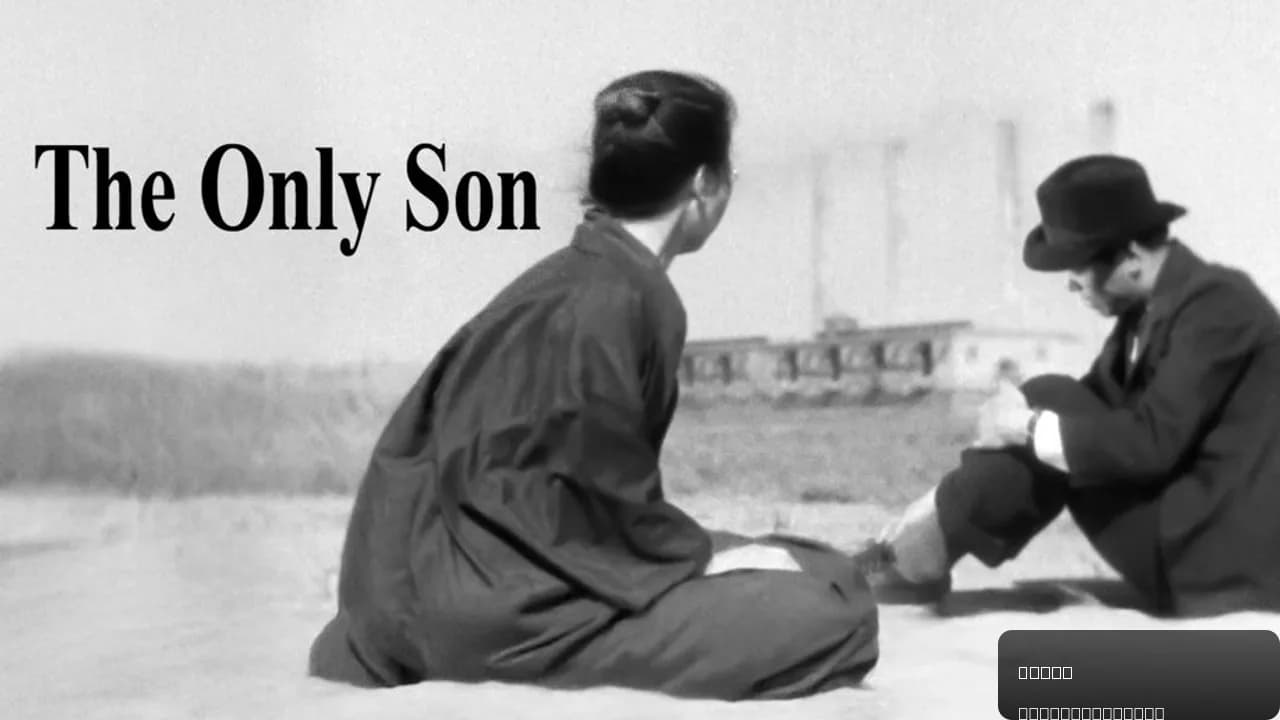
The Story of The Only Son and Its Portrait of Family Heartbreak
Yasujirō Ozu's The Only Son tells a deceptively simple story that unfolds across decades. A widowed mother in rural Japan works herself to exhaustion in a textile mill, scripting and saving every yen so her only child can escape poverty through education. She believes — as mothers do — that her sacrifice will elevate him beyond the economic struggle that's consumed her own life. Years pass. The son grows into a man, moves to Tokyo, and builds what looks like a respectable life. Then his mother makes the journey to the city to see him, expecting to find success. What she discovers instead is something far more complicated: a man who's become ordinary, unfulfilled, and trapped in the same economic precarity she'd hoped to spare him. The meeting between them becomes a reckoning neither quite knows how to navigate.
Behind the Making of The Only Son and Ozu's Transition to Sound
The Only Son arrived in 1936 as Ozu's first feature-length sound film — a significant moment for a director already known for his meticulous silent work. The transition to dialogue could've derailed a visual stylist like Ozu, but he adapted with characteristic precision. The cast, led by the remarkable Chōko Iida as the mother and Shinichi Himori as the son, brought lived-in authenticity to roles that could've collapsed into melodrama in lesser hands. Yoshiko Tsubouchi, Masao Hayama, and Chishū Ryū rounded out a ensemble that felt less like actors performing and more like people living through their circumstances. The production itself was modest by international standards — no elaborate sets, no dramatic orchestration — which actually strengthened the film's power. Ozu shot it with the same compositional discipline he'd brought to his silents, framing characters against architectural geometry and negative space in ways that made their emotional isolation visible without spelling it out. The film didn't dominate box offices or rack up major international awards at the time (the mid-1930s weren't kind to Japanese cinema in Western markets), but it established Ozu as a director who could harness sound not as spectacle but as texture — voices sometimes muffled, conversations trailing off, silence doing as much work as speech.
Why The Only Son Endures and What Makes It Stand Out
What's striking about The Only Son is how it refuses to let anyone off the hook — not the mother for her controlling sacrifice, not the son for his passivity, not the viewer for wanting a neat resolution. The film doesn't judge them; it just watches, and that restraint is what makes it sting. There's a scene late in the film where the mother and son sit together in his cramped Tokyo apartment, and the weight of their mutual disappointment fills the frame more than any dialogue could. He's disappointed because he can't be the success she imagined. She's disappointed because she's confronting the possibility that sacrifice alone doesn't guarantee redemption — that sometimes you work yourself to the bone and your child still ends up struggling, still ends up ordinary. The thing nobody mentions is that Ozu never lets us feel superior to either of them. We don't get to sit back and think, "Well, if only they'd communicated better," or "If only he'd tried harder." Instead, we're left with something closer to the truth: two people who love each other, bound by economics and expectation and the simple fact that parents and children can't actually save each other, no matter how much they want to.
The performances carry this weight without ever becoming theatrical. Iida's mother doesn't have a breakdown or a big emotional scene — she just gradually realizes the shape of her disappointment, and her face tells you everything. Himori's son isn't a villain or a coward; he's just a man doing his best in a system that doesn't reward "best" very generously. Ozu's camera stays at a distance, respecting their privacy even as it documents their pain. Shot and edited with what critics have called his "customary exquisite control," the film moves with the pace of lived experience rather than plot mechanics. Scenes breathe. Transitions happen quietly. You're not watching a story unfold so much as sitting in a room with these people as their lives settle into their final shape.
Where to Stream The Only Son Online
The Only Son has found its way onto numerous streaming platforms, making Ozu's masterpiece far more accessible than it was even a decade ago. You can find it on Movie OTT, which tracks current availability across services like Amazon Prime Video, Criterion Channel, Max, and several others. The Criterion Channel is perhaps the ideal home for it — they've restored the film beautifully, and the presentation honors Ozu's compositional precision in ways that really matter for a director so concerned with visual geometry. If you've got a Criterion subscription (or want one), that's your best bet. But the film's also available through Amazon Prime Video with Ads, HBO Max, Plex, Apple TV Store, and Google Play Movies, so there's no real excuse to miss it. Some regions also have it on TCM, U-NEXT, or BFI Player. Check the where-to-watch widget at the top of this page for real-time availability in your area — streaming rights shift constantly, and you don't want to hunt for a platform that's dropped it.
Frequently asked questions
Q: Is The Only Son based on a true story?
No, it's a fictional narrative written specifically for the screen. That said, the economic conditions and family dynamics it portrays were deeply rooted in the lived reality of 1930s Japan, where industrialization and poverty shaped millions of families exactly like the one in the film.
Q: Who directed The Only Son?
Yasujirō Ozu directed it. This was his first feature-length sound film, marking a major transition in his career from silent cinema. He'd go on to become one of cinema's greatest directors, but many critics consider The Only Son among his finest achievements.
Q: How long is The Only Son?
The film runs just under 90 minutes, which is remarkable given how much emotional and temporal ground it covers. Ozu doesn't waste a frame, but he also doesn't rush — the pacing feels generous even at that length.
Q: What's the IMDb rating for The Only Son?
The film sits at 5.9 out of 10 on IMDb, which honestly tells you more about IMDb's user base than about the film itself. Critics and serious film scholars regard it as a masterpiece; casual viewers sometimes find it slow or emotionally draining. That gap is worth paying attention to.
Q: Why does the mother visit her son in Tokyo?
She comes to see how his life has turned out — to confirm that her decades of sacrifice have paid off. What she finds is far more complicated than simple success or failure, which is what makes their reunion so devastating.
Final Thoughts on The Only Son
If you're coming to The Only Son expecting a feel-good family reunion story, you'll be disappointed — which is partly the point. Ozu made a film about disappointment that doesn't soften its edges with sentiment or false hope. It's a work that trusts you to sit with discomfort, to watch two people fail each other not out of malice but out of the simple fact that love and sacrifice don't always bend the world to our will. That's not a crowd-pleaser, but it's the truth. And it's why, nearly 90 years later, this 1936 film still feels urgent and necessary.