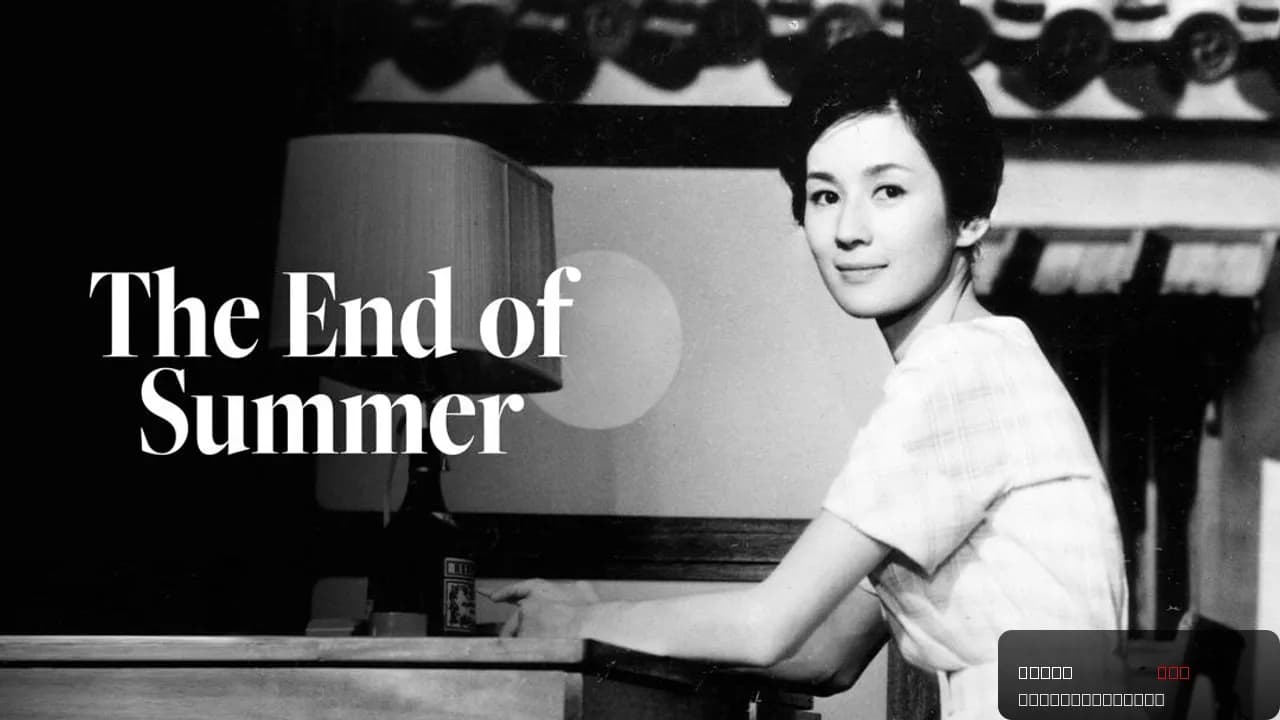
The story of The End of Summer and its family at the heart
The End of Summer follows a brewery manager in Kyoto as he attempts to steer his household through the aftermath of his wife's passing. It's not a melodrama—there's no orchestral swelling or histrionic breakdown. Instead, Ozu presents grief as something that sits quietly at the dinner table, in the spaces between conversations about sake production and a daughter's marriage prospects. The film's central tension isn't explosive; it's the slow, inevitable friction between what a man thinks he owes his family and what his family actually needs from him. What begins as a story about managing a business becomes a meditation on the things we can't manage at all—time, aging, the ways people slip away from us even when they're still in the room.
Behind the making of The End of Summer and Ozu's final years
The End of Summer arrived in 1961 as Ozu's penultimate film, made for Toho Films before he would return to Shochiku to make An Autumn Afternoon (1962), which would be his final work. The film was entered into the 12th Berlin International Film Festival, cementing Ozu's status as one of cinema's most respected voices at a moment when Japanese cinema was gaining serious international recognition. Setsuko Hara—arguably Ozu's most frequent collaborator and the emotional anchor of his late work—leads an ensemble that includes Yōko Tsukasa, Keiju Kobayashi, and Hisaya Morishige. The runtime of 103 minutes might sound modest by modern standards, but Ozu never wastes a second; every scene earns its place. The production reflects the meticulous craftsmanship Ozu was known for—minimal camera movement, compositions that feel almost architectural, and a visual language that had become his signature by the early 1960s. This was a director working at the absolute height of his powers, even as he was aware (though audiences didn't yet know) that he had only one more film left to make.
What makes The End of Summer stand out as Ozu's meditation on mortality
What's striking about The End of Summer is how it refuses the easy emotional beats. There's a scene—I won't spoil the specifics—where a character receives news that could shatter everything, and the response is so understated, so human, that it lands harder than any outburst could. That's the Ozu signature: he trusts the audience to feel what isn't being said. The performances don't feel acted in the Western sense; they feel observed, as if Ozu simply pointed a camera at life and captured it. Hara, in particular, brings a kind of weary grace to her role—she's not fighting against the current of events so much as learning to float with them. The film's engagement with the Shōwa era (1926-89) isn't nostalgic; it's elegiac. We're watching a world of family breweries, traditional hierarchies, and unspoken obligations begin to shift. Ozu was fascinated by how modernity was arriving in Japan—not as invasion, but as inevitability—and how people of a certain generation had to make peace with it. The sake brewery becomes a metaphor for something larger: the slow fermentation of time, the way traditions age, the question of what gets passed down and what gets left behind. Critics have long noted that Ozu's late films are obsessed with time and mortality, and The End of Summer is perhaps the clearest expression of that preoccupation. It's not depressing, exactly. It's more like watching someone you care about come to terms with something true.
How to stream The End of Summer online across multiple platforms
If you're looking to watch The End of Summer, you've got several options. The film is currently available on Criterion Channel, which makes sense given Criterion's deep commitment to Ozu's work and Japanese cinema more broadly. You can also find it on Max, Prime Video, Apple TV Store, and a handful of international platforms including Filmin, U-NEXT, and Kanopy. The specific platform you'll want depends on your region and existing subscriptions—Movie OTT tracks current streaming availability across these services, so you can see exactly where it's available in your area without hunting through multiple apps. For the best presentation, Criterion's restoration is worth seeking out if you have access to their channel, though the film's stark, deliberately composed cinematography translates well across formats.
Frequently asked questions
Q: Who directed The End of Summer?
Yasujirō Ozu directed The End of Summer in 1961. It was his second-to-last film—only An Autumn Afternoon (1962) would follow—and represents the work of a master filmmaker at the peak of his creative powers.
Q: Is The End of Summer based on a true story?
No, The End of Summer is an original screenplay, not based on a novel or real events. However, Ozu drew heavily on his observations of Japanese family life and the cultural shifts happening during the Shōwa era.
Q: What's the runtime of The End of Summer?
The film runs 103 minutes. Despite its modest length, Ozu packs enormous emotional and thematic weight into every frame, with virtually no wasted moments.
Q: Where can I watch The End of Summer?
The End of Summer is available on multiple platforms including Criterion Channel, Max, Prime Video, Apple TV Store, Filmin, U-NEXT, and Kanopy. Check the Where to Watch widget at the top of this page for current availability in your region.
Q: Why is The End of Summer considered one of Ozu's best films?
The film showcases Ozu's mastery of visual composition, his ability to extract profound emotion from understated moments, and his fascination with time, aging, and family obligation. It's a work of rare philosophical depth disguised as a quiet family drama.
Final thoughts on The End of Summer and why it endures
There's something almost defiant about a film this quiet, this patient, this willing to let silences speak. In an era of constant stimulation, The End of Summer asks you to sit still and watch people struggle with things they can't quite articulate. That's not a flaw—it's the entire point. Ozu knew he was near the end of his own life when he made this film (he died in 1963), and that knowledge seems to inform every choice. This isn't a film about grand gestures or dramatic revelations. It's about the small, irreplaceable moments that make up a life, and the way we're all, in the end, trying to hold onto something that's already slipping away.