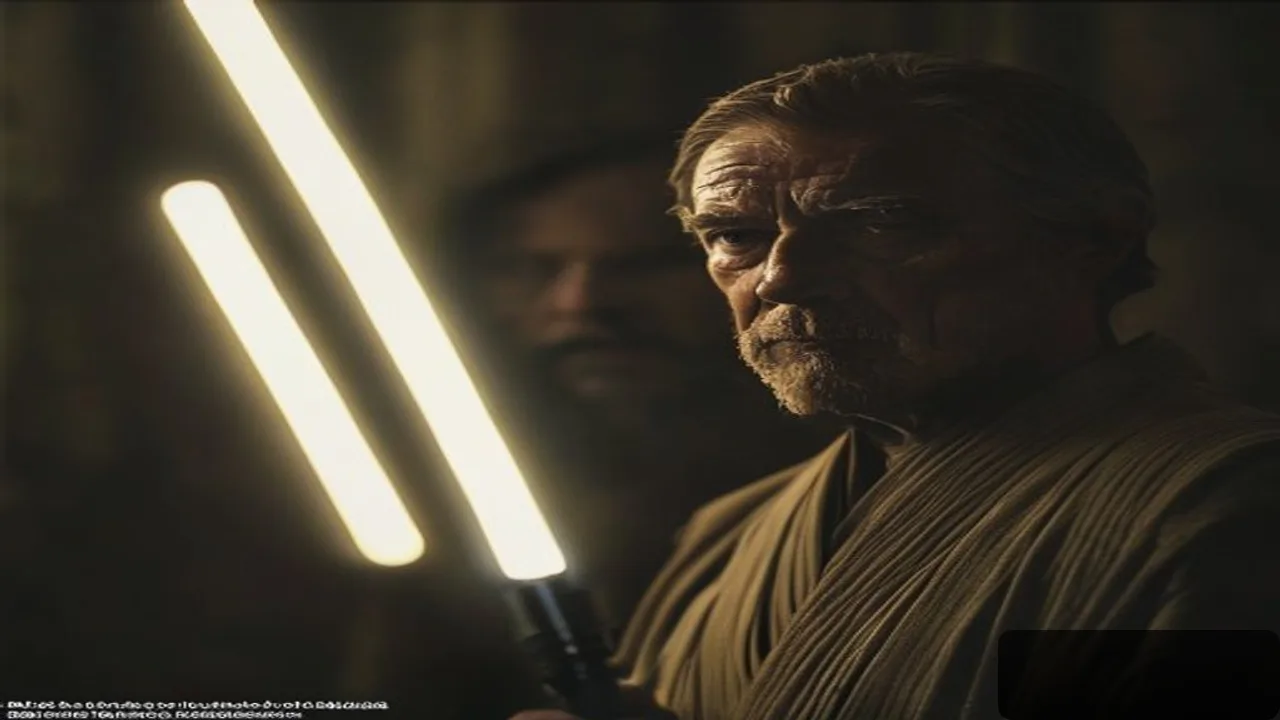
When Alec Guinness Told Ian McKellen to Stay Silent on Gay Rights
Ian McKellen has revealed that Alec Guinness — Obi-Wan Kenobi himself — once took him to lunch in Pimlico specifically to beg him to abandon his LGBTQ+ advocacy work. McKellen ignored the advice. Decades later, the story is finally getting the attention it deserves.
"He thought it somewhat unseemly for an actor to dabble in public or political affairs and advised me, sort of pleaded with me, to withdraw." That's Ian McKellen, speaking to The Guardian, recalling a private lunch with Alec Guinness that took place sometime around 1989 — a lunch that looked, on the surface, like a friendly meal between two celebrated British actors, and turned out to be something far more loaded. McKellen had just helped co-found Stonewall, the UK lobbying group that was pushing the government to extend equal legal protections to gay and lesbian citizens. Guinness, it seems, had heard about it and wasn't pleased.
The Pimlico Lunch Nobody Knew About Until Now
The setting alone tells you something. Not a West End restaurant. Not a private club. Pimlico — quiet, residential, discreet. According to McKellen's account in The Guardian, Guinness invited him for an Italian meal, made small talk for a while, and then got to the point. He'd heard about McKellen's involvement with Stonewall and wanted him to step back. The reasoning, as McKellen recalled it, was generational and almost quaint: an actor simply shouldn't mix himself up in politics. It was, in Guinness's framing, a matter of professional propriety.
McKellen didn't follow the advice. He said so plainly: "Advice from an older generation, which I didn't follow."
What brought this memory back to the surface was a touring solo play called Two Halves of Guinness, performed by Zeb Soanes. McKellen saw the production recently and noted that it "hints at Sir Alec's latent bisexuality in a way that would have upset him, I suppose." That parenthetical — "I suppose" — carries a lot of weight. It's McKellen being careful, respectful even, while still naming something that Guinness himself clearly never wanted named publicly.
A few key facts worth establishing here:
- Ian McKellen came out publicly on BBC Radio in 1988, at the age of 48.
- Stonewall UK was co-founded in 1989, the year after Section 28 — the Thatcher-era legislation banning the "promotion" of homosexuality in schools — was passed into law.
- Alec Guinness died in 2000. He never publicly addressed questions about his own sexuality.
- McKellen first encountered Guinness backstage during a 1979 production of Bent, a play about the persecution of gay men in Nazi concentration camps. Guinness declined to join him for supper at that meeting.
According to reporting from The Independent, this isn't the first time McKellen has spoken about Guinness's resistance to gay advocacy. A 2014 account corroborates the general shape of the story, including a reported plea from Guinness that McKellen not mix acting with "anything as dirty as homosexuality." Whether those were Guinness's exact words or McKellen's paraphrase of a broader sentiment, the message was consistent across decades.
Why Guinness's Silence Was Its Own Kind of Statement
Here's what strikes me most about this story: Alec Guinness wasn't just advising discretion. He was, whether consciously or not, policing the line between acceptable public identity and the kind of advocacy that might actually change things. There's a version of "stay quiet" that comes from fear. And there's a version that comes from a genuine belief that one's professional persona should be kept separate from one's private life or political convictions. Guinness may have held both simultaneously.
What's striking is that Guinness himself — a man who, according to McKellen, had "latent bisexuality" hinted at in that recent solo play — was asking another gay man to suppress the very kind of public fight that might have made Guinness's own private life less fraught. The irony isn't subtle.
British cinema of Guinness's era was, of course, built on a certain kind of performance: controlled, technically brilliant, emotionally guarded. Think of his Oscar-winning work in The Bridge on the River Kwai (1957), or his earlier postwar comedies at Ealing Studios. That generation of actors — many of them gay, bisexual, or simply unbothered by conventional categories in private — learned to keep their lives compartmentalized. Professionally, publicly, entirely. It wasn't cowardice, exactly. It was survival, and then it became habit, and then for some it became principle.
McKellen came from a different tradition. Not a braver one, necessarily — just a later one, shaped by different pressures.
McKellen's Own Words on Coming Out and What Closets Cost
Variety reported that McKellen, speaking to The Times of London last year, made his position on LGBTQ+ visibility about as clear as it's possible to be: "I have never met anybody who came out who regretted it. Being in the closet is silly — there's no need for it. Don't listen to your advisers, listen to your heart."
That's not a throwaway line. McKellen has said versions of it for decades, and the consistency matters. He came out in 1988 — not at the height of his career, not when it was easy, but in the middle of the AIDS crisis, during a BBC radio debate about Section 28. He didn't plan the announcement. He just said it. And then kept saying it.
He's also pointed out, repeatedly, that there has never been an openly gay Best Actor Oscar winner. Not one. And there has never been an openly gay Premier League footballer, despite the fact that statistically, there almost certainly are gay players in the league right now. "The first Premier League footballer to come out," McKellen told The Times, "will become the most famous footballer in the world, with all the agencies begging for his name on their products."
Hard to argue with that logic. Hard to say if the industry has actually internalized it.
How This Story Lands for Indian Audiences and Streaming Viewers
For Indian audiences, both McKellen and Guinness are primarily known through their blockbuster franchise work — McKellen as Gandalf in the Lord of the Rings trilogy and Magneto across multiple X-Men films, Guinness as Obi-Wan Kenobi in the original Star Wars trilogy. Both franchises have enormous followings on the subcontinent.
The Lord of the Rings extended editions are currently available on Prime Video India, while the Star Wars original trilogy and prequel films stream on Disney+ Hotstar. Movie OTT tracks current streaming availability across all major Indian platforms — useful if you want to revisit either actor's most iconic work after reading about this story.
The LGBTQ+ angle, it's worth noting, lands differently in India than in the UK or US. Section 377 — the colonial-era law criminalizing same-sex relations — was struck down by the Supreme Court of India only in September 2018. The conversation McKellen was having in 1989, fighting for basic legal equality, is one that India was still having three decades later. That context makes his defiance of Guinness's advice feel less like a historical footnote and more like a reminder of how recently these battles were still being fought in democratic countries.
McKellen's most recent film, The Christophers, directed by Steven Soderbergh, has not yet confirmed an Indian streaming window. Movie OTT's where-to-watch tracker will have updated availability information as regional deals are announced.
Alec Guinness: The Contradictions of a Legend
Alec Guinness (1914–2000) remains one of the most technically accomplished British actors of the twentieth century. His career spanned six decades and crossed every genre — Shakespearean theatre, Ealing comedy, literary adaptation, and eventually the science fiction blockbuster that introduced him to a generation that had no idea who he was.
A brief timeline of his major work:
- 1949–1955: Ealing Studios comedies, including Kind Hearts and Coronets (in which he played eight roles), The Lavender Hill Mob, and The Ladykillers
- 1957: The Bridge on the River Kwai — Academy Award for Best Actor
- 1977: Star Wars: A New Hope — Oscar nomination for Best Supporting Actor
- 1980–1983: The Empire Strikes Back and Return of the Jedi
- 1988: Knighted for services to drama
Guinness converted to Roman Catholicism in 1956, a fact that some biographers have connected to his complicated relationship with his own identity. He was married to Merula Salaman from 1938 until her death in 2000, just weeks before his own. Whether his reported bisexuality was something he acted on, suppressed, or simply lived with privately is something that — as McKellen acknowledged — he almost certainly would have preferred never to be discussed at all.
For the full release history of Guinness's Star Wars appearances and current streaming details, Movie OTT has the franchise page.
What Comes Next — for McKellen, and for the Conversation
Ian McKellen, now 86, shows no signs of going quiet. The Christophers, his latest collaboration with Steven Soderbergh, is currently making the rounds at festivals. No wide release date has been confirmed for international markets as of this writing, and streaming rights remain unannounced.
The primary keyword in this story — McKellen's gay rights advocacy, and what Alec Guinness thought of it — isn't going away. The solo play Two Halves of Guinness, starring Zeb Soanes, is currently on a UK touring run and appears to be sparking exactly the kind of reassessment of Guinness's legacy that the man himself would have dreaded. Whether that reassessment is fair, or welcome, or overdue, is a question worth sitting with.
For streaming availability of McKellen's and Guinness's back catalogues across India, the US, the UK, and Spain, check Movie OTT for the most current platform listings.