









The story of Always: Sunset on Third Street '64
Always: Sunset on Third Street '64 unfolds against one of Japan's most pivotal moments—the 1964 Tokyo Olympics. The film finds the residents of Third Street at a crossroads, their old neighborhood poised on the edge of transformation as the nation rushes toward the future. The narrative centers on Mutsuko, who becomes romantically entangled with a seemingly perfect young doctor whose true nature remains shrouded in mystery, and Chagawa, a writer whose career has stalled while he grapples with the profound responsibility of raising a boy who isn't biologically his own. What's striking is how the film refuses to separate these intimate personal crises from the larger historical moment unfolding around them. The Olympics aren't just a backdrop—they're a pressure cooker, forcing every character to confront who they are and who they want to become as their world reshapes itself with bewildering speed.
Set in the shitamachi (old downtown) district, the film captures a vanishing Tokyo, one where wooden buildings still stand and neighbors know each other's business, where tradition and modernity collide on every corner. The 1960s Japan depicted here sits squarely within the Shōwa era, a period of astonishing economic transformation that would reshape the nation's identity. For those unfamiliar with the historical context, this was the moment when Japan stopped looking backward and began its meteoric rise as a global economic power—and the human cost of that ascent forms the emotional core of this story.
Behind the making of Always: Sunset on Third Street '64
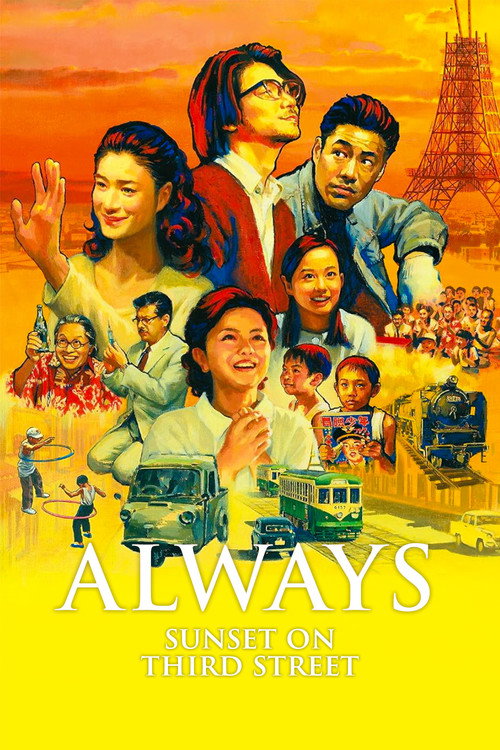
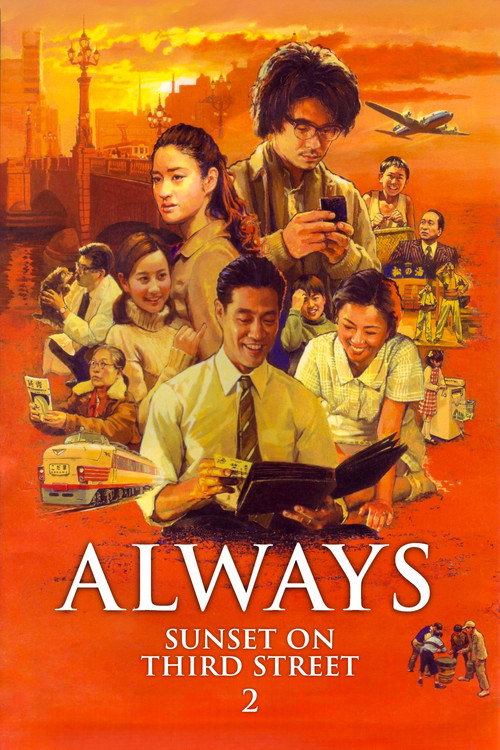
Always: Sunset on Third Street '64 arrives as the third installment in the Always: Sunset on Third Street franchise, following the original film and Always: Sunset on Third Street 2 (2007). Director Takashi Yamazaki adapts Ryōhei Saigan's manga with a filmmaker's eye for both intimate character moments and sweeping historical canvas. Released on January 21, 2012, the film emerged from a massive production apparatus—a collaboration between Nippon Television Network Corporation, TOHO, Chukyo TV Broadcasting, and a constellation of other major Japanese media companies including dentsu, Shogakukan, and VAP. That kind of institutional backing speaks to the franchise's cultural weight in Japan, though it's hardly a guarantee of quality.
The 142-minute runtime gives Yamazaki room to breathe, to let scenes simmer and characters reveal themselves gradually rather than through exposition dumps. The cast brings considerable pedigree to their roles, though this isn't a Hollywood-style prestige ensemble—it's built on the foundation of Japanese television and film talent, actors who understand the rhythms of melodrama without tipping into sentimentality. On the critical front, the film holds a respectable 7.2/10 on IMDb, suggesting it found an appreciative audience even if it didn't achieve the kind of universal acclaim that might've pushed it into the Western critical consciousness. Box office figures for Japanese regional releases can be opaque, but the franchise's longevity and the scale of its production suggest it performed solidly in its home market.
What makes Always: Sunset on Third Street '64 resonate with audiences
Honestly, the film's greatest strength is its refusal to choose between the personal and the historical. That's harder to pull off than it sounds—most films either make history a mere setting or subordinate character drama to grand themes. Yamazaki manages both. When Mutsuko navigates her confusing attraction to the doctor, we're not just watching a romance; we're watching a woman trying to claim agency in a society that's modernizing faster than its gender roles can adapt. When Chagawa wrestles with his identity as a father, we're seeing a man confronting what it means to build something real in an era obsessed with building bigger, faster, newer. The performances don't announce themselves—they're understated, the way Japanese cinema often prefers it, which can feel like restraint to Western viewers accustomed to more theatrical displays of emotion.
What I keep coming back to is the film's visual sense of place. The shitamachi locations aren't romanticized as quaint relics; they're lived-in spaces where real people navigate real problems. There's a scene where the encroachment of Olympic construction literally frames the characters' conversations—the old and new Tokyo literally occupying the same shot. That kind of visual storytelling doesn't require dialogue or exposition. It just shows you what's at stake. The film also understands that the Japanese economic miracle wasn't universally celebrated—for many, it meant displacement, loss of community, the dissolution of ways of life that had persisted for generations. By anchoring the story in Third Street's residents, the film gives voice to those who experienced modernization as something closer to rupture than progress.
Where to stream Always: Sunset on Third Street '64 online
Always: Sunset on Third Street '64 is currently available on major OTT services—check the Where to Watch widget at the top of this page to see which platforms are streaming it in your region right now. Streaming availability shifts regularly, so Movie OTT makes it easy to track where the film is currently accessible rather than hunting through multiple services yourself. If you're looking to revisit the franchise or exploring Japanese cinema from the 2010s, knowing where to find it without the runaround is half the battle. The film's 142-minute runtime makes it a substantial commitment, so you'll want to know you can actually access it before you set aside an evening.
Frequently asked questions
Q: Who directed Always: Sunset on Third Street '64?
Takashi Yamazaki wrote and directed the film. He's known for balancing intimate character work with larger historical and social themes, a skill that proves essential to the film's success in weaving personal drama with the backdrop of Tokyo's Olympic transformation.
Q: Is Always: Sunset on Third Street '64 based on a true story?
The film is based on Ryōhei Saigan's manga Sunset on Third Street, so while the specific characters and plot are fictional, they're grounded in the real historical moment of 1960s Tokyo during the lead-up to the 1964 Olympics and Japan's rapid economic transformation.
Q: Do I need to watch the earlier Always: Sunset on Third Street films first?
While Always: Sunset on Third Street '64 is technically the third installment in the franchise, it functions well as a standalone film. That said, if you're curious about the characters' history and want the full emotional weight, watching the previous films will deepen your investment—though it's not strictly necessary to follow this one.
Q: What's the runtime, and is it worth the commitment?
The film runs 142 minutes, which is substantial but not excessive for a character-driven drama. The pacing is deliberate rather than rushed, giving scenes room to breathe, so whether it feels worth the time depends on your patience for slower, more introspective storytelling.
Q: Where can I watch Always: Sunset on Third Street '64?
The film is available on several major OTT platforms. Check the streaming availability widget at the top of the page to see which services currently have it in your area, as availability varies by region and changes periodically.
Final thoughts on Always: Sunset on Third Street '64
Always: Sunset on Third Street '64 won't blow you away with flashy technique or shocking plot twists. What it does instead—and what makes it worth your time—is sit quietly with people caught between worlds, between who they were and who they're becoming. It's a film about loss dressed up as a film about progress, and it understands that those two things aren't opposites. If you're drawn to character-driven narratives, Japanese cinema, or historical dramas that resist easy answers, this one's worth seeking out. The shitamachi setting and the 1960s Shōwa-era context give it a specificity that lingers long after the credits roll.