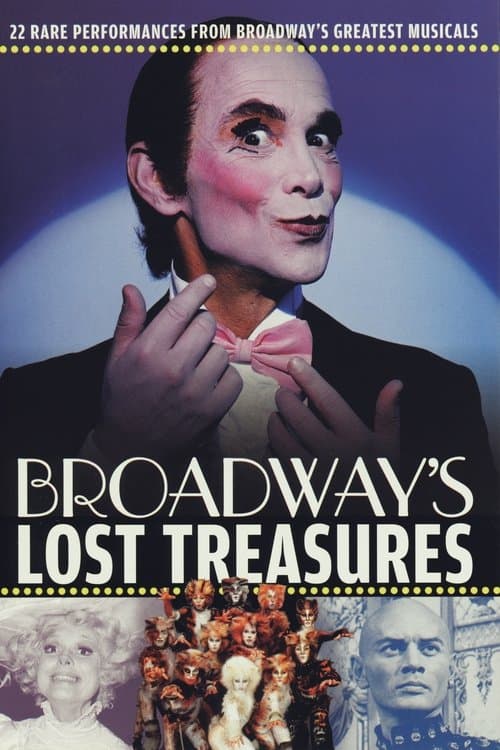










The Story Behind Broadway's Lost Treasures
Broadway's Lost Treasures captures something precious and increasingly hard to find: the actual performances that made the Tony Awards matter. Released in 2003, this documentary isn't a talking-heads retrospective or a celebrity-interview special. It's a straight-ahead archival piece—22 performances pulled directly from Tony Award broadcasts between 1967 and 1986, the era when Alexander H. Cohen and his wife Hildy Parks produced the ceremony. What makes this collection genuinely valuable is the restoration work. These aren't the grainy, color-shifted recordings that aired decades ago. The footage has been color-corrected and the sound digitally remastered, which means you're actually watching these performances the way they deserved to be seen.
The premise is almost deceptively simple: here are the moments that mattered. The songs that stopped the room. The performers at their peak, captured live on a single take with nowhere to hide. No second takes, no studio polish, just the raw electricity of live Broadway. The 110-minute runtime moves briskly from one performance to the next, letting the work speak for itself rather than padding the experience with unnecessary commentary or context. It's refreshing, honestly—a documentary that trusts its material enough not to over-explain it.
How Broadway's Lost Treasures Came Together
Produced by Acorn Media Enterprises, Broadway's Lost Treasures emerged from a specific archival mission: preserve and restore these broadcasts before the original masters degraded beyond recovery. The Tony Awards during the Cohen era (1967-1986) represented the height of the ceremony's cultural relevance, a time when the broadcast itself was an event that commanded serious production values and attracted top-tier talent. Cohen and Parks understood the ceremony's role as a showcase, and they treated it that way—these weren't hastily assembled variety segments but carefully curated performances meant to represent Broadway at its finest.
The restoration process itself deserves mention. Color correction on footage from the late 1960s through the mid-1980s is no trivial task. Film stock degrades, colors shift, and what looked acceptable on a 1970s television can look muddy and unwatchable on modern displays. The team behind this project had to make judgment calls about what the original intent probably was, working backward from degraded materials to something that honors both the performance and the era it came from. You can feel that care in the final product. The sound restoration is equally important—dialogue and orchestration that might have been buried under tape hiss and technical artifacts gets lifted out, making the performances feel immediate and present rather than historical artifacts.
The project didn't generate major box-office numbers (it's a documentary release on a specialty label, after all), but it found its audience among theatre historians, performers, and fans who recognized its value. IMDb users have given it a 6.417 rating, which reflects a core appreciation tempered by the reality that not every performance will land equally for every viewer—and that's fine. This isn't a movie designed to appeal to everyone. It's designed to preserve something specific.
What Makes Broadway's Lost Treasures Stand Out
Here's what's striking about watching this collection: you're not just seeing great performances, you're seeing the moment when Broadway knew it had to document itself. The 1960s and 1970s were when live television was still the primary way most Americans encountered Broadway—you couldn't stream a show, couldn't buy a ticket easily, couldn't even get a decent bootleg recording. The Tony Awards broadcast was often your only shot at seeing these artists perform these roles. That weight hangs over every number. The performers aren't phoning it in for a broadcast; they're delivering the definitive version of something, and they know it.
What nobody mentions about collections like this is how they reveal changes in taste and style. The orchestrations sound different than they do in modern revivals. The vocal techniques are different. The staging choices reflect a different era's assumptions about what theatre should be. You'll notice, watching these performances back-to-back, how much more theatrical—more presentational, less naturalistic—Broadway used to be. That's not a criticism. It's just a fact that becomes obvious when you're looking at 22 examples spanning nearly two decades.
The performances themselves carry real weight. These aren't second-string casts or rehearsal footage. These are the original Broadway stars, often performing the defining roles of their careers. The energy is palpable, even through a screen, even through decades of tape degradation and restoration. There's a directness to live performance that studio recording can't quite capture, and that's what you get here—the unvarnished thing itself. Not every number lands with equal force (some feel dated, some feel timeless), but that variation is part of the documentary's honest appeal. It's not a highlight reel pretending everything was perfect. It's a time capsule.
Where to Watch Broadway's Lost Treasures Online
Broadway's Lost Treasures is currently available on major OTT services, and Movie OTT tracks where you can stream it right now. Since availability shifts between platforms and regions, the Where to Watch widget at the top of this page shows you exactly which services have it in your area. If you're a theatre fan or a musical enthusiast, it's worth checking your preferred streaming apps—this is the kind of documentary that tends to live on specialty services and streaming platforms focused on arts and culture content. The restoration quality means it's worth watching on the best screen you have available, so if you've got access to a larger display, that's worth waiting for rather than watching on a phone.
Frequently Asked Questions
Q: What years do the performances in Broadway's Lost Treasures cover?
The documentary features performances from Tony Award broadcasts between 1967 and 1986, the period when Alexander H. Cohen and Hildy Parks produced the ceremony. This span captures what many consider Broadway's golden age of live television presentation.
Q: Why was the footage color-corrected and remastered?
The original broadcast materials had degraded over decades, with color shifts and audio problems making them difficult to watch. The restoration work brings these performances back to watchable quality while honoring the original performances and era.
Q: Is Broadway's Lost Treasures a documentary about the Tony Awards or about Broadway?
It's both. The film uses Tony Award broadcasts as its source material, but the focus is on the 22 musical performances themselves rather than on the awards ceremony or its history. It's essentially a curated archive of landmark Broadway moments.
Q: How long is Broadway's Lost Treasures?
The film runs 110 minutes, moving through performances without extensive commentary or context—it lets the work speak for itself.
Q: Who produced Broadway's Lost Treasures?
Acorn Media Enterprises produced the documentary, which was released in 2003 as a restoration and archival project to preserve these performances.
Final Thoughts on Broadway's Lost Treasures
Broadway's Lost Treasures works best if you approach it as what it is: a time capsule, not a narrative film. You're not watching for plot or character development. You're watching to understand what Broadway sounded like, looked like, and felt like during a specific era, captured by performers who were often the best of their generation. It's a gift for theatre lovers, a resource for historians, and a reminder that some things—live performance, especially—deserve to be preserved and restored rather than left to fade. If that sounds like your kind of documentary, it's worth seeking out.