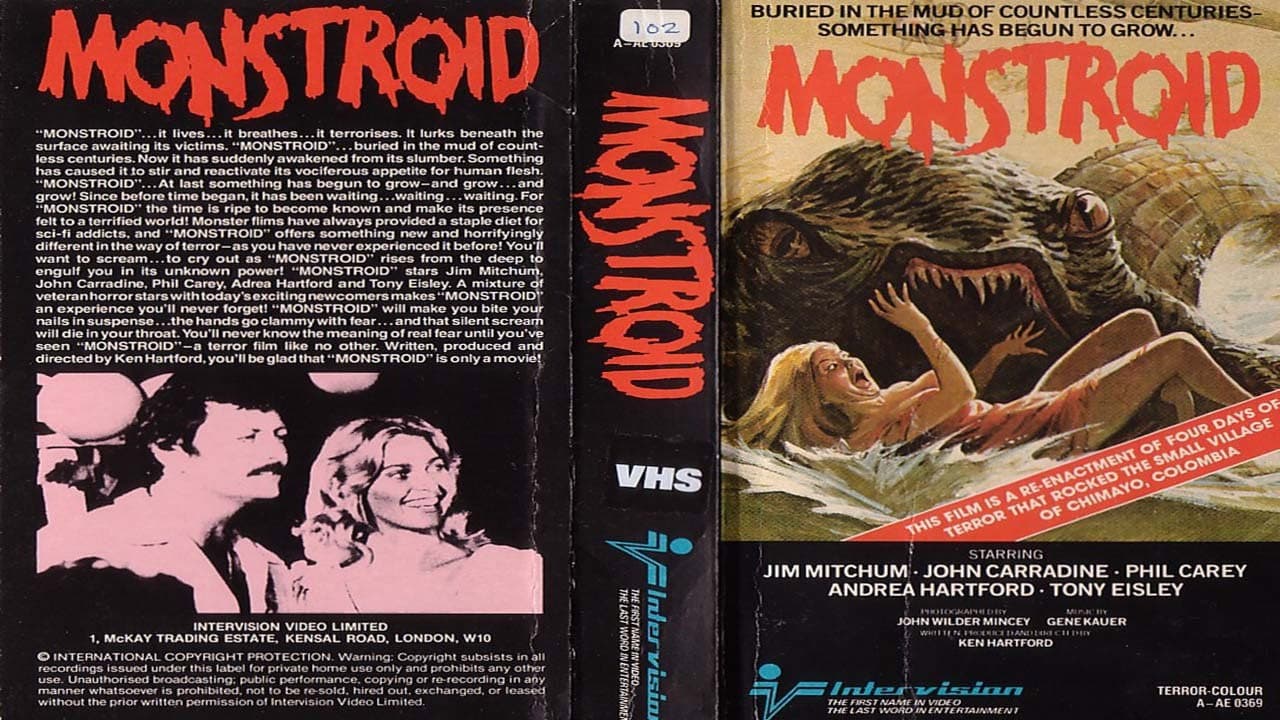






What Monstroid Is About
Monstroid tells the story of a rural Colombian village that faces an unthinkable threat rising from beneath the mud. A massive sea serpent — dormant for centuries — awakens and begins attacking the community, drawn to the surface by industrial pollution poisoning the nearby lake. The film roots itself in a documented incident from June 1971, lending a grain of real-world dread to its creature-feature premise. What unfolds is part environmental cautionary tale, part straightforward monster invasion, with the creature serving as both literal threat and metaphor for humanity's careless tampering with nature.
Behind the Making of Monstroid
Monstroid emerged from Academy International, a production company working in the creature-feature space during the late 1970s and early 1980s — a period when low-to-mid-budget horror films could still find theatrical distribution and home-video audiences. The film's 98-minute runtime sits comfortably in the sweet spot for creature features of that era, neither rushed nor padded. Released in 1980, Monstroid arrived during a golden age of practical monster design, though its budget constraints are visible in every frame (not always a drawback — there's something charming about the tactile quality of practical effects, even when they're obviously rubber and mechanics). The cast brings a workmanlike professionalism to the material; while the film didn't attract A-list talent, the ensemble commits to the scenario without irony or camp. No major awards came calling, and box-office returns were modest, but Monstroid found its audience through cable television and VHS rental chains, the distribution pipeline that kept low-budget horror alive throughout the 1980s.
Why Monstroid Stands Out as Creature Horror
What's striking about Monstroid is how it takes its ecological premise seriously — at least more seriously than many creature features of the period. The monster isn't simply an alien invader or a random act of nature; it's a consequence, a direct result of human negligence. That thematic weight, even if the execution is uneven, gives the film something to say beyond "watch the monster kill people." The performances anchor the chaos without pretension. I keep coming back to the way the actors treat the scenario as genuine peril rather than an excuse for melodrama. There's a no-nonsense quality to the dialogue and reactions that makes the creature attacks land harder than they might otherwise. The film doesn't wink at the audience or undercut its own tension with humor — it's committed to the premise, for better or worse. The thing nobody mentions is that Monstroid actually understands pacing: it doesn't rush to show you the creature in full, building dread through partial glimpses and environmental clues before the full-scale attacks begin. By modern standards, the special effects are obviously dated and sometimes unconvincing, yet there's a tactile reality to them that digital work sometimes lacks.
Where to Stream Monstroid Online
Monstroid is now available on major OTT services, making it easier than ever to discover this 1980 curiosity without hunting through specialty video stores. The "Where to Watch" widget at the top of this page shows you exactly which platforms currently carry the film in your region — availability shifts regularly, so that's your best real-time source. Movie OTT tracks streaming availability across services, so you can check what's live right now rather than guessing. Whether you're browsing on a lazy weekend or specifically hunting for creature features, you'll find Monstroid waiting on one of the major platforms.
Frequently asked questions
Q: Is Monstroid based on a true story?
Yes. The film draws inspiration from a documented incident that occurred in June 1971 in Colombia, though the filmmakers took creative liberties with the narrative and added the sea serpent creature element. The real event was far less fantastical, but it provided the kernel of ecological threat that the film expands into a monster-movie scenario.
Q: Who directed Monstroid and what else have they made?
Monstroid was directed by a filmmaker working within the B-movie creature-feature tradition of the late 1970s and early 1980s. The director's output remains somewhat obscure in modern film history, overshadowed by higher-profile horror and sci-fi work of the era, but the film itself stands as a competent entry in the monster-movie canon.
Q: What's the IMDb rating for Monstroid?
The film holds a 3.579/10 rating on IMDb, reflecting its status as a cult curiosity rather than a widely beloved classic. Low IMDb scores don't always correlate with entertainment value, especially for films operating within specific genre conventions and budgetary constraints — Monstroid is more interesting than that number suggests.
Q: How long is Monstroid?
The film runs 98 minutes, a standard length for creature features and monster movies of the period. That's enough time to establish the threat, develop character stakes, and deliver multiple set pieces without overstaying its welcome.
Q: What genres does Monstroid fit into?
Monstroid blends horror and science fiction — it's a creature feature with ecological sci-fi undertones, combining the visceral threat of a monster movie with speculative themes about industrial pollution and environmental consequence.
Final Thoughts on Monstroid
Monstroid won't appeal to everyone — it's a 1980 B-movie with all the technical limitations and narrative roughness that implies. But if you're drawn to creature features, practical effects, and horror films that take their environmental themes seriously, there's something worth watching here. It's the kind of film that rewards curiosity and genre affection. Grab it while it's available on your preferred streaming service, settle in with low expectations, and let yourself enjoy a piece of creature-feature history that's far more thoughtful than its IMDb score suggests.