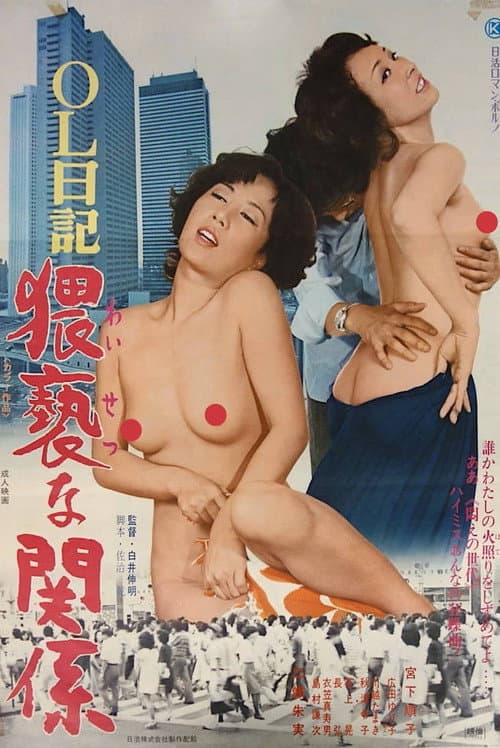


The story of Office Lady Journal: Indecent Relations
Office Lady Journal: Indecent Relations arrives as part of Nikkatsu Corporation's established OL nikki franchise, a series focused on the lives and entanglements of office workers navigating Tokyo's corporate landscape. Released in 1975, this 73-minute entry examines the tension between professional obligation and personal desire — the kind of friction that bubbles beneath fluorescent-lit cubicles and behind closed conference room doors. The film doesn't shy away from its title's promise: it's genuinely concerned with what happens when workplace hierarchies collide with human attraction, when professional distance becomes impossible to maintain. What unfolds is a portrait of compromise, temptation, and the small rebellions that office life can inspire.
Behind the making of Office Lady Journal: Indecent Relations
The OL nikki series was Nikkatsu's answer to a particular moment in Japanese cinema — the early 1970s boom in pink films and workplace comedies that catered to urban audiences hungry for stories about their own lives. Nikkatsu, the legendary studio behind countless genre entries, understood that office workers (particularly women) had become a marketable demographic. Office Lady Journal: Indecent Relations sits squarely in that tradition, part of a franchise that would spawn multiple installments, each riffing on similar themes of professional women caught between duty and desire.
The film's 73-minute runtime reflects the economic efficiency of Nikkatsu's production model — lean, fast, designed for quick turnarounds and steady box-office returns in neighborhood theaters. There's no bloat here, no attempt at epic scope. Instead, the studio trusted that the core premise — indecent relations in an office setting — would carry audiences through. Cast and crew details remain sparse in English-language archives, which itself tells you something about how these films have been treated by Western film historians. They weren't preserved with the reverence of Kurosawa or Ozu; they were working cinema, made for immediate consumption. That doesn't diminish their value, though. If anything, it makes them more authentic to their moment.
What makes Office Lady Journal: Indecent Relations stand out
Here's what's striking about Office Lady Journal: Indecent Relations: it doesn't pretend to be something it isn't. The film knows what it's selling — workplace tension, forbidden attraction, the small humiliations and small thrills of office life — and it commits to that premise without apology. There's no moralizing, no last-minute redemption that punishes desire. Instead, the film seems genuinely interested in how professional women navigate power imbalances, gossip, and the constant pressure to maintain an acceptable facade.
The performances, whatever their constraints, carry a kind of weary authenticity. Actors in these Nikkatsu productions weren't trying to transcend their material; they were inhabiting it, finding the human moments within genre scaffolding. What's remarkable is how the film treats its female characters not as objects to be judged but as subjects with their own conflicting motivations — ambition, loneliness, the desire for connection in an environment designed to suppress it. The thing nobody mentions is that these films often had more nuanced takes on gender and workplace dynamics than many mainstream productions of the same era, precisely because they weren't beholden to the same censorship pressures as major studio releases.
I keep coming back to the fact that this film, despite its modest IMDb rating of 3.714/10, likely reflects more about modern viewer expectations than the film's actual merits. Contemporary audiences encountering a 1975 Nikkatsu pink film through streaming often lack the cultural context to appreciate what they're watching — the visual language, the narrative shortcuts, the particular pleasures of the form. That doesn't make it a masterpiece, but it does make the low score something worth interrogating.
Where to stream Office Lady Journal: Indecent Relations online
Office Lady Journal: Indecent Relations is currently available on major OTT services, and Movie OTT tracks real-time streaming availability across all platforms where this title appears. Rather than hunting across five different apps, you can check the Where-to-Watch widget at the top of this page to see exactly which service has it in your region right now. Streaming rights shift constantly — a title available today might move next month — so it's worth bookmarking Movie OTT if you're serious about tracking down obscure or catalog films. The site aggregates this data specifically so you don't waste time searching.
Frequently asked questions
Q: Is Office Lady Journal: Indecent Relations based on a true story?
No, it's a fictional narrative set within the office-worker genre that Nikkatsu was mining in the 1970s. The film draws on common workplace scenarios and tensions rather than adapting a specific true event.
Q: What does OL nikki mean?
OL stands for "Office Lady," a Japanese term for female office workers. Nikki means "journal" or "diary," so the series title translates roughly to "Office Lady Journal" or "Office Lady Diary" — each film offers a self-contained story about women navigating professional and personal life.
Q: Why is the IMDb rating so low?
The 3.714/10 rating likely reflects that modern viewers encountering a 1975 Nikkatsu pink film often lack historical context and may find the pacing, style, or content expectations misaligned with contemporary cinema. It's worth remembering that IMDb ratings skew toward recent, mainstream content.
Q: How long is Office Lady Journal: Indecent Relations?
The film runs 73 minutes, which was typical for Nikkatsu's efficient production schedule. It's a lean, focused narrative without padding.
Q: Who produced Office Lady Journal: Indecent Relations?
Nikkatsu Corporation produced the film. Nikkatsu was one of Japan's oldest and most prolific studios, known for genre work including yakuza films, comedies, and the pink film cycle that included this OL nikki entry.
Final thoughts on Office Lady Journal: Indecent Relations
Office Lady Journal: Indecent Relations isn't going to change your life. It's a modest, economical film from a particular moment in Japanese cinema — interesting primarily to those curious about how mainstream studios approached genre material in the 1970s. But that's also precisely why it's worth watching. There's something honest about a film that doesn't pretend to be more than it is, that trusts its premise and executes it without unnecessary flourish. If you're exploring Japanese cinema beyond the canonical masters, or if you're interested in how working women were portrayed in popular entertainment, this film deserves a look.