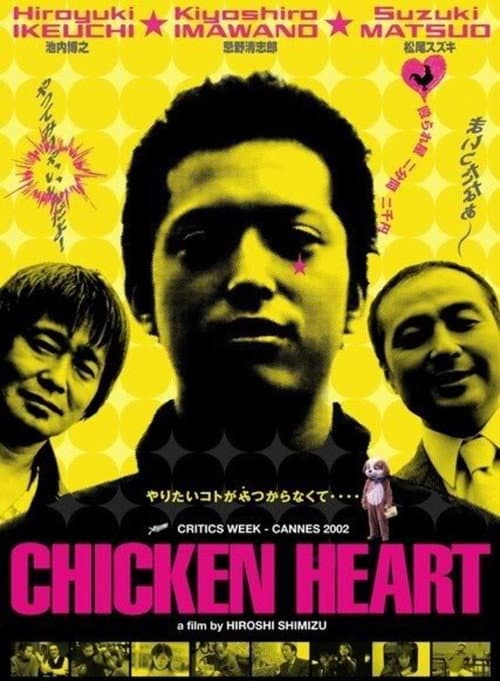






The story of Chicken Heart: Three lives in limbo
Chicken Heart tells the deceptively simple story of three men bound by proximity rather than ambition. Iwano, a former boxer, has drifted into work as a human punching bag for drunk businessmen in Tokyo's entertainment district—a job that's less a career and more a way to avoid thinking about the future. His neighbors Sada and Maru aren't doing much better; they're content to exist in the margins, avoiding anything that might actually require commitment or growth. The three have perfected the art of going nowhere, which works fine until the day an eviction notice arrives. Their apartment building is coming down. The compensation they receive covers their remaining rent, but it doesn't solve the real problem: they've lost their place to live, and more importantly, they've lost the excuse for not having a place to go. What unfolds isn't a dramatic scramble or a redemption arc—it's something quieter and stranger. Each man must figure out, for perhaps the first time, what he actually wants.
Behind the making of Chicken Heart: Production, cast, and critical standing
Chicken Heart arrived in 2002 as a distinctly Japanese entry in the comedy-drama space, capturing a particular moment in contemporary Japanese cinema when filmmakers were increasingly interested in the lives of ordinary people stuck in ordinary ruts. The 105-minute runtime allows the film to breathe without rushing its characters toward convenient resolutions. At 7.6 out of 10 on IMDb, the film has attracted a steady following among viewers who appreciate its refusal to sentimentalize poverty or underemployment. The cast performances anchor the film's success—these aren't flashy roles, which is precisely the point. Iwano's exhaustion, Sada's resignation, and Maru's barely concealed anxiety feel lived-in rather than performed. The film doesn't rely on star power or franchise recognition; instead, it trusts its ensemble to carry the emotional weight of characters who've made a habit of not mattering. Production details remain modest, befitting a story about men with modest means, yet the film's technical craft—its framing, its pacing, its use of Tokyo's urban landscape as both setting and character—suggests a filmmaker with genuine control over their vision. Movie OTT tracks where films like this one find their audience across streaming platforms, and Chicken Heart's steady presence on major services speaks to its enduring appeal among viewers looking for something beyond formula.
What makes Chicken Heart stand out: Performance and the poetry of stagnation
The thing that strikes you about Chicken Heart is how it refuses to judge its characters for their passivity. There's no moment where Iwano suddenly discovers his "true calling" or where Maru finds redemption through self-discovery. Instead, the film sits with these men in their inertia, and in doing so, it finds something almost poetic about it. What's genuinely interesting is how the screenplay treats eviction not as a tragedy but as a disruption—a forced reckoning that these three have been avoiding. The performances capture this beautifully; there's a weariness in every gesture, a kind of defeated acceptance that life happens to you rather than for you. The cinematography mirrors this mood—Tokyo feels less like a thriving metropolis and more like a maze of identical streets and anonymous rooms where nothing changes until suddenly everything does. I keep coming back to how the film handles the aftermath of the eviction notice. Rather than cutting to dramatic job interviews or tearful goodbyes, it lingers on mundane moments: packing, walking through familiar neighborhoods knowing you'll never see them again, the strange freedom and terror of having nowhere to be. This is where Chicken Heart earns its 7.6 rating—not through spectacle, but through an almost anthropological attention to how ordinary people navigate displacement. The supporting performances matter too; even minor characters feel like they're living their own quiet struggles, which deepens the film's overall texture.
Where to stream Chicken Heart online
Chicken Heart is available across major OTT services, making it accessible to anyone curious about this understated gem. You'll find it listed on the streaming-availability widget at the top of this page, which tracks real-time updates across platforms. Rather than being locked behind a single service, the film's presence on multiple platforms reflects its status as a legitimate piece of cinema worth preserving and discovering. Whether you're browsing on a weeknight or planning a deeper dive into Japanese comedy-drama, Movie OTT's aggregated listings make it simple to find where it's currently streaming in your region. The film's 105-minute length makes it perfect for a single sitting, and its modest production values mean it doesn't demand a premium viewing experience—a standard streaming quality is more than sufficient.
Frequently asked questions
Q: What year was Chicken Heart released?
Chicken Heart came out in 2002. It's now over two decades old, yet it hasn't aged in the way films often do—its themes about aimlessness and displacement feel, if anything, more relevant.
Q: How long is Chicken Heart?
The film runs 105 minutes, which gives it enough time to develop its characters and situations without overstaying its welcome. It's a lean runtime that respects the viewer's time while still allowing for quiet, contemplative moments.
Q: Who are the main characters in Chicken Heart?
The story centers on Iwano, a former boxer working as a punching bag for drunk customers; Sada; and Maru—three men living in the same apartment building who must figure out their lives after receiving an eviction notice.
Q: What's the IMDb rating for Chicken Heart?
Chicken Heart holds a 7.6 out of 10 on IMDb, reflecting a strong reception among viewers who appreciate its understated approach to character-driven storytelling.
Q: Is Chicken Heart based on a true story?
While the film isn't explicitly based on one person's life, it draws from the experiences of many people living on the margins of Japanese urban society—making it feel documentary-like in its authenticity, even if the specific narrative is fictional.
Final thoughts on Chicken Heart: Who should watch
Chicken Heart isn't a film for everyone, and that's okay. It won't give you a hero's journey or a tidy moral. What it will give you is a genuine look at how people live when they've stopped trying—and what happens when circumstances force them to start again. If you're tired of plot-driven narratives and character arcs that resolve themselves, this is worth your time. If you want to see three actors inhabit uncertainty with real skill, watch it. It's a film that understands that sometimes the most interesting stories are the ones where nothing much happens, until suddenly everything does.