







The story of Pleasure Campus: Secret Games
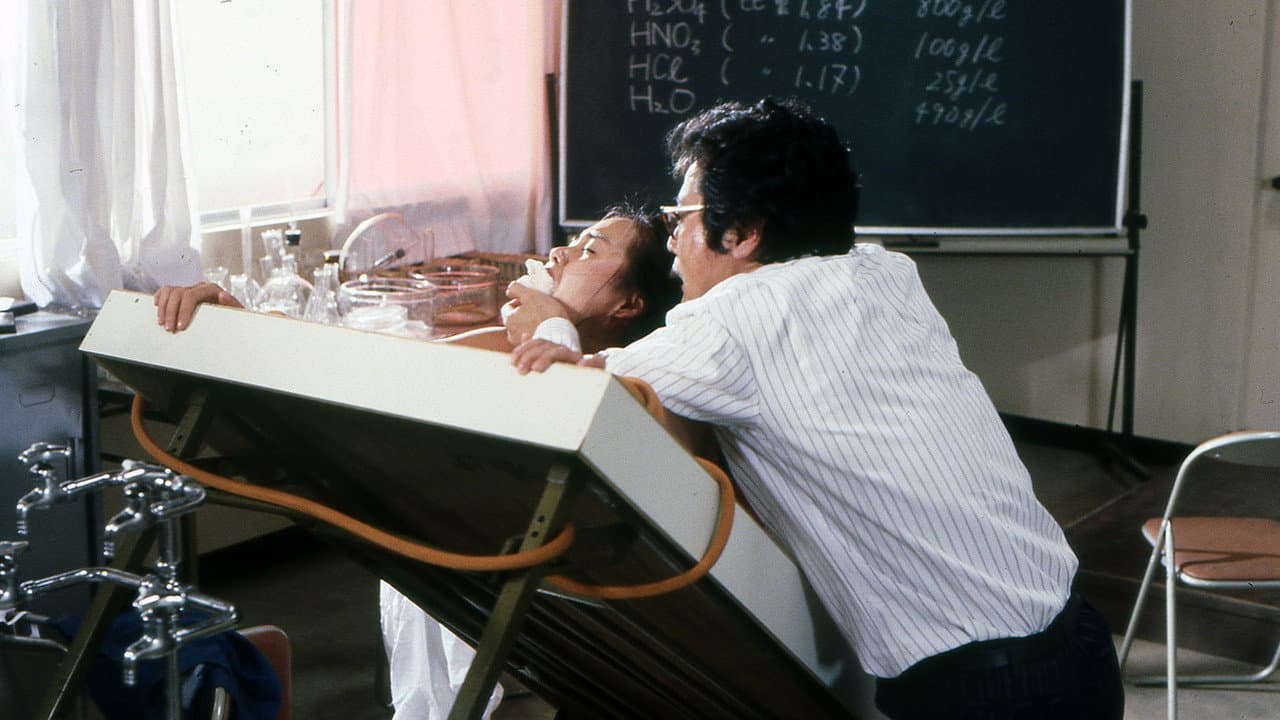
Pleasure Campus: Secret Games opens with a premise that's deliberately provocative—a high school girl disrupts her class and is sent to the lab to clean equipment as punishment. What unfolds from that moment is a darkly comedic spiral into institutional cruelty and sexual coercion. The film doesn't shy away from its source material, Michio Hisauchi's graphic novel, but instead leans into the uncomfortable absurdity of the scenario. She's alone in the lab. Horny and frustrated. And that's when things take a turn she won't recover from for the rest of the film's lean 64-minute runtime. What makes the early setup work—despite its transgressive subject matter—is the film's refusal to play it straight. There's a comedic touch to the chaos that follows, a kind of gallows humor that keeps the narrative from becoming purely exploitative, even as the content itself remains shocking and deliberately uncomfortable for the viewer.
Once a teacher discovers her in a compromising position with lab equipment, the punishment escalates from there—a parade of authority figures, each with their own brand of humiliation in mind, each encounter more absurd and disturbing than the last. The girl's escape home offers no refuge; her parents, rather than offering protection, decide this is the perfect moment to provide what they call a "perverse sexual education." It's a bleak worldview the film presents: every authority figure—school, family—becomes complicit in her degradation. Movie OTT helps viewers track where these kinds of provocative, difficult films are currently streaming, since titles this transgressive don't always have obvious homes on mainstream platforms.
Behind the making of Pleasure Campus: Secret Games
Pleasure Campus: Secret Games arrived in 1980 as a product of Nikkatsu Corporation, the legendary Japanese studio that had already built a reputation for pushing boundaries in cinema. Director Tatsumi Kumashiro was no stranger to controversial material—he was a master artist known for adapting graphic novels and manga with a willingness to embrace their most shocking elements. The film's adaptation of Michio Hisauchi's work wasn't an attempt to soften the source material or make it palatable for mainstream audiences. Instead, Kumashiro doubled down on the graphic nature of the narrative while introducing comedic timing and stylistic flourishes that gave the proceedings a darkly absurdist tone.
The runtime of just 64 minutes is worth noting—this is a lean, punchy film that doesn't linger or build slowly. It moves with the speed of a fever dream, piling incident upon incident without pause for reflection. The brevity works in the film's favor, actually, because it prevents the viewer from settling into a comfortable viewing experience. You're constantly off-balance, which is precisely the point. Nikkatsu's willingness to greenlight and distribute this material in 1980 speaks to a different era in Japanese cinema, one where exploitation and art-house sensibilities could coexist on the same screen. The film's IMDb rating of 5.3 out of 10 reflects its divisive nature—some viewers see it as a legitimate artistic statement about institutional power and sexual violence, while others find it difficult to separate the transgressive content from any underlying critique.
What makes Pleasure Campus: Secret Games stand out
What's striking about this film is how it refuses to wink at the camera or apologize for its premise. There's no narrator stepping in to condemn the characters' actions, no final scene where justice is served. The comedy—and there is genuine comedy here, dark as it gets—comes from the sheer escalation of absurdity rather than from the girl's suffering itself. That distinction matters. The film isn't laughing at her; it's laughing at the systems that enable her abuse, at the predictable cruelty of authority figures who use their power to satisfy their own desires. Each new encounter with a teacher or parent brings a new variation on the theme, each one slightly more ridiculous than the last, which is how the film manages to be both deeply uncomfortable and somehow darkly funny.
Kumashiro's direction keeps things visually interesting despite the film's modest budget and runtime. He doesn't need long takes or elaborate cinematography to communicate the girl's growing sense of helplessness and dread. The pacing itself becomes a tool—cutting quickly from one scene to the next, never allowing the viewer to fully process what they've just witnessed before the next indignity arrives. The performances, too, commit fully to the material without irony or distance. That commitment is what makes the film work as satire rather than simple exploitation. If the actors played it as a joke, the whole thing would collapse into pure trash. Instead, they treat the material with the seriousness it demands, which paradoxically makes the absurdity hit harder. When you're tracking down where to find difficult films like this, Movie OTT's streaming guides help you understand not just where they're available, but what you're actually getting into.
Where to stream Pleasure Campus: Secret Games online
Pleasure Campus: Secret Games is currently available on major OTT services, though availability varies by region and changes regularly. The specific platforms carrying the film are listed in the "Where to Watch" widget at the top of this page, which updates in real-time to reflect current streaming partnerships. Because this is a Nikkatsu title from 1980 with a provocative reputation, it doesn't show up on every mainstream platform—you'll likely find it on specialty streaming services or international catalogs rather than on the most popular general-audience services. If you're interested in Japanese cinema from this era, particularly the more experimental and boundary-pushing work that came out of the late 1970s and early 1980s, checking the widget is your fastest way to see what's available right now. Streaming rights for older, controversial titles can shift, so it's worth verifying availability before you settle in to watch.
Frequently asked questions
Q: Who directed Pleasure Campus: Secret Games?
Tatsumi Kumashiro directed the film. He was a master artist known for adapting graphic novels and manga, and he brought his characteristic willingness to embrace transgressive material to this 1980 Nikkatsu production.
Q: Is Pleasure Campus: Secret Games based on a true story?
No, it's based on Michio Hisauchi's graphic novel. The film is a fictional narrative, though it engages with real themes about institutional power and sexual violence through a darkly comedic lens.
Q: How long is Pleasure Campus: Secret Games?
The film runs 64 minutes, making it a lean and punchy experience that moves quickly from one scene to the next without lingering.
Q: What's the IMDb rating for Pleasure Campus: Secret Games?
The film has an IMDb rating of 5.3 out of 10, reflecting its divisive nature among viewers who interpret its transgressive content and dark comedy in different ways.
Q: Where can I watch Pleasure Campus: Secret Games?
The film is available on major OTT services. Check the "Where to Watch" widget at the top of this page for current streaming availability in your region, as rights can vary and change over time.
Final thoughts on Pleasure Campus: Secret Games
Pleasure Campus: Secret Games isn't a film for everyone—its transgressive content and refusal to provide moral clarity will alienate plenty of viewers, and that's by design. But for those interested in provocative Japanese cinema, in satire about institutional power, or in understanding how 1980s Nikkatsu pushed boundaries, it's a genuinely interesting artifact. The film's brevity works in its favor, and Kumashiro's direction keeps things visually and narratively sharp. It's a difficult watch, sure. But it's also a film that sticks with you, that makes you think about why you're uncomfortable, what exactly you're objecting to. That's not nothing. That's actually cinema doing what it does best—forcing a conversation.